The Meaning Behind Punjabi Sikh Wedding Rituals
Introduction to Punjabi Sikh Weddings
Punjabi Sikh weddings are not just grand celebrations filled with vibrant colors, rhythmic dhol beats, and mouthwatering food—they are deeply spiritual journeys wrapped in layers of tradition. If you’ve ever attended one, you know the energy is electric. The bride glows in rich red or pastel hues, the groom stands tall in his turban, and families gather not just to witness a union, but to bless a sacred covenant. But beneath the glitter and the grandeur lies something far more profound: a spiritual commitment rooted in Sikh philosophy.
At the heart of every Sikh wedding is the concept of unity—not just between two individuals, but between souls walking together toward the Divine. In Sikhism, marriage isn’t about possession or dominance. It’s about partnership. It’s about two people choosing to walk side by side, supporting each other as equals while keeping Waheguru (God) at the center of their lives.
You might wonder—why are there so many rituals? Why the music, the prayers, the symbolic gestures? Each ceremony, whether it’s the intimate Kurmai or the powerful Laavan, carries meaning. Nothing is random. Every step is intentional, designed to remind the couple that marriage is both a worldly and spiritual responsibility.
Punjabi culture adds its own vibrant flavor to Sikh wedding traditions. Think of it as spirituality wrapped in celebration. The rituals blend discipline with joy, devotion with dance. It’s like a symphony—every instrument has its place, and when they come together, the result is unforgettable.
In this article, we’re going to peel back the layers of these beautiful rituals. We’ll explore what they truly mean, why they matter, and how they shape not just a wedding day—but an entire married life.
Historical and Spiritual Roots of Sikh Marriage
To truly understand Punjabi Sikh wedding rituals, you have to go back to the foundation of Sikhism itself. Sikhism, founded in the 15th century by Guru Nanak Dev Ji, emphasizes equality, devotion to one God, honest living, and service to humanity. Marriage within Sikhism reflects all of these principles.
The Sikh wedding ceremony is known as “Anand Karaj,” which literally translates to “Blissful Union.” This term wasn’t chosen lightly. It signifies that marriage is meant to be a joyful spiritual experience, not merely a social contract. The Anand Karaj ceremony was formalized during the time of Guru Amar Das Ji, the third Sikh Guru, who composed the Laavan—the four sacred hymns recited during the wedding ceremony.
Before Sikhism, many wedding rituals in India were deeply rooted in caste divisions and rigid hierarchies. Sikh Gurus challenged these norms. They rejected caste discrimination and emphasized that all human beings are equal in the eyes of God. This revolutionary thinking shaped Sikh marriage traditions. The bride and groom sit side by side in the Gurdwara, symbolizing equality. There is no concept of dowry in true Sikh teachings. Marriage is not a transaction; it is a spiritual partnership.
Historically, Sikh marriages were simple and centered entirely around prayer and community blessing. Over time, Punjabi cultural elements—music, dance, elaborate attire—became intertwined with the religious ceremony. Yet the spiritual core remains unchanged.
Think of Sikh marriage like a tree. The roots are firmly planted in spiritual teachings. The trunk represents commitment and equality. The branches—colorful and expressive—are the cultural traditions that make Punjabi weddings so lively.
Understanding this historical and spiritual foundation helps us see that every ritual is more than just tradition. It’s a living reflection of Sikh values passed down through generations.
The Philosophy of Marriage in Sikhism
Marriage in Sikhism is not viewed as a mere social arrangement or a romantic partnership alone. It is seen as a sacred journey where two souls unite to walk on the path of righteousness together. The ultimate goal? Spiritual growth and closeness to Waheguru.
Unlike some belief systems that promote asceticism as the ideal path, Sikhism encourages household life, or “Grihastha.” The Gurus taught that one does not need to renounce the world to find God. Instead, one can achieve spiritual enlightenment while living a balanced life—earning honestly, sharing with others, and remembering God daily. Marriage becomes a vital part of this balanced existence.
In Sikh philosophy, husband and wife are equals. There is no hierarchy where one dominates the other. Guru Nanak Dev Ji strongly spoke against the oppression of women, asking, “Why call her bad, from whom kings are born?” This spirit of equality is woven into the fabric of Sikh marriage rituals.
The relationship is often compared to two wheels of a cart. If one wheel falters, the journey becomes difficult. Both partners must move in harmony. Love, respect, patience, and faith become the fuel that drives this cart forward.
Another beautiful metaphor often used is that of two rivers merging into one. After marriage, individuality remains, but the direction becomes shared. The couple supports each other’s spiritual growth, reminding one another of their higher purpose.
So when you witness a Punjabi Sikh wedding, remember: it’s not just about the couple promising to live together. It’s about promising to grow together, pray together, and face life’s storms as a united front anchored in faith.
Pre-Wedding Rituals: Setting the Sacred Tone
Before the wedding day even arrives, a series of meaningful pre-wedding rituals begin shaping the spiritual and emotional atmosphere. These ceremonies are not random festivities—they serve as preparation, both inward and outward.
In Sikh families, marriage isn’t just between two individuals; it’s between two families and communities. Pre-wedding rituals create bonds, build familiarity, and foster mutual respect. They set the tone for unity and joy.
Spiritually, these rituals act as grounding moments. Families often begin with Ardaas (prayer), seeking blessings from Waheguru for a smooth journey ahead. This emphasis on prayer reminds everyone involved that despite the excitement, the wedding’s foundation is spiritual devotion.
There’s also an emotional layer to these rituals. Think about it: a wedding marks a major life transition. The bride and groom are stepping into new roles and responsibilities. Pre-wedding ceremonies help them process this shift gradually. Surrounded by loved ones, they receive advice, blessings, and encouragement.
Culturally, Punjabi pre-wedding functions are vibrant and energetic. Laughter fills the house, relatives travel from far and wide, and homes buzz with preparation. Yet, even amid the celebration, spiritual grounding remains central.
It’s like preparing soil before planting a seed. The wedding day is the seed, but these pre-wedding rituals enrich the soil—ensuring that the marriage grows strong and rooted in love, faith, and community support.
Roka Ceremony: The First Step Toward Unity
The Roka ceremony marks the official beginning of the wedding journey. Think of it as the moment when two families say, “Yes, this is meant to be.” While it may seem simple on the surface—just a gathering with blessings and sweets—it carries deep emotional and cultural weight.
The word Roka literally means “to stop.” Symbolically, it signifies that the bride and groom have stopped searching for life partners because they have found each other. From this point forward, both families publicly acknowledge the relationship. There’s a sense of reassurance and commitment in the air. It’s no longer just a private understanding—it’s a shared promise.
Spiritually, the ceremony often begins with an Ardaas at the Gurdwara or at home. Families seek Waheguru’s blessings for harmony, love, and a successful marriage. This emphasis on prayer at such an early stage sets the tone: the union is guided by divine will, not just personal desire.
Culturally, gifts and sweets are exchanged between families. But here’s the important part—these gifts are not meant to symbolize wealth or status. In Sikh philosophy, humility matters. The true “gift” is the acceptance of one another as extended family. The sweet offerings represent the sweetness hoped for in the couple’s life together.
Emotionally, the Roka creates a bridge. Before this moment, two families may have been strangers. After it, they begin building a relationship that will last generations. It’s like planting a flag that says, “We’re in this together.”
In modern times, Roka ceremonies may be intimate or grand, depending on the family. Yet at its core, the meaning remains unchanged—a heartfelt commitment that marks the beginning of a sacred journey.
Kurmai (Engagement Ceremony): A Spiritual Commitment
The Kurmai ceremony, often referred to as the formal engagement, takes the commitment a step deeper. If Roka is the announcement, Kurmai is the blessing. Traditionally held in the Gurdwara, this ceremony is centered around prayer, humility, and spiritual grounding.
During the Kurmai, the groom is presented with a kara (steel bracelet) and sometimes a kirpan, reinforcing his responsibility to live by Sikh values. The bride may receive symbolic gifts, and rings are exchanged in many modern ceremonies. But the true essence lies not in the jewelry—it lies in the Ardaas.
Why is prayer so central here? Because Sikh marriage is not just about compatibility; it’s about shared spiritual purpose. The families gather before the Guru Granth Sahib, acknowledging that the ultimate witness to this commitment is Waheguru. That’s powerful when you think about it. It shifts the focus from societal approval to divine guidance.
There’s also something beautifully equal about the Kurmai. Unlike some traditions where engagement is one-sided, Sikh ceremonies emphasize mutual consent and respect. Both the bride and groom are active participants in their journey forward.
You can think of Kurmai as the foundation stone of a house. Without it, the structure lacks stability. With it, everything built afterward stands firm. It’s a moment of reflection amid the excitement—a reminder that marriage is sacred, intentional, and rooted in faith.
Akhand Path: Invoking Divine Presence
One of the most spiritually profound pre-wedding rituals is the Akhand Path—a continuous, uninterrupted recitation of the entire Guru Granth Sahib. This reading typically takes about 48 hours and is conducted either at the Gurdwara or at home.
Now pause for a second and imagine this. For two full days, sacred hymns fill the space without interruption. The sound current of Gurbani flows like a river, creating an atmosphere of peace and devotion. It’s not just a ritual; it’s a spiritual cleansing.
The purpose of the Akhand Path before a wedding is to invite divine presence into the marriage. Families believe that immersing the environment in Gurbani purifies thoughts, intentions, and emotions. It prepares everyone—especially the bride and groom—for the sacred commitment ahead.
The ceremony concludes with a Bhog, marking the completion of the reading, followed by Ardaas and distribution of Karah Prasad. This communal sharing reinforces unity and gratitude.
Spiritually speaking, the Akhand Path is like setting a compass. Before embarking on the lifelong journey of marriage, the couple aligns themselves with Sikh teachings. It’s a reminder that no matter what challenges arise in married life, returning to Gurbani offers guidance and strength.
In today’s fast-paced world, taking 48 hours for continuous prayer may seem extraordinary. But that’s precisely the point. It emphasizes that marriage deserves intentional spiritual preparation—not just logistical planning.
Maiyan and Vatna Ceremony: Cleansing and Renewal
The Maiyan and Vatna ceremony is often one of the most intimate and joyful pre-wedding events. Held separately for the bride and groom, it involves applying a turmeric-based paste (Vatna) to their skin. While it may look like playful fun—and it certainly is—it holds deeper meaning.
Turmeric has long been associated with purification and healing in South Asian culture. Symbolically, applying Vatna represents cleansing the individual before entering married life. It’s not just about glowing skin for wedding photos—it’s about spiritual and emotional renewal.
Family members apply the paste lovingly, often teasing and laughing along the way. There’s something incredibly grounding about this. The ritual brings generations together—grandparents, cousins, siblings—all participating in preparing the bride or groom for a new chapter.
On a symbolic level, Maiyan represents transition. It’s like shedding an old layer and stepping into a new identity. The bride is about to become a wife; the groom is about to become a husband. This ceremony gently marks that transformation.
The color yellow, often worn during Maiyan, symbolizes prosperity and positivity. It reflects the hope that the couple’s life together will be vibrant and filled with light.
In essence, the Maiyan ceremony is both cleansing and comforting. It reassures the bride and groom that they are supported, loved, and surrounded by blessings as they prepare to step into marriage.
Mehndi Ceremony: Art, Joy, and Hidden Meanings
The Mehndi ceremony is where creativity meets celebration. Intricate henna designs are applied to the bride’s hands and feet, often incorporating symbols of love, prosperity, and spirituality. But Mehndi is more than decorative art—it tells a story.
Henna has cooling properties, symbolizing calmness and patience—qualities essential for a successful marriage. The deeper the color of the Mehndi, tradition says, the stronger the love between the couple. While that might sound poetic, it reflects a broader truth: marriage thrives on warmth and care.
Designs often hide the groom’s initials within the patterns. This playful tradition encourages intimacy and bonding. It’s like a secret message woven into art.
The Mehndi ceremony is also a celebration of feminine strength and joy. Surrounded by music and laughter, the bride is reminded that marriage is not about losing herself—it’s about stepping confidently into a new role with grace and support.
Think of Mehndi as storytelling through design. Each swirl and motif represents hope, protection, and new beginnings. It’s a celebration of beauty, yes—but also of resilience and love.
Sangeet Night: Celebrating Community and Connection
If there’s one event that captures the vibrant spirit of Punjabi culture, it’s the Sangeet. Filled with music, dance, and energetic performances, this night is pure celebration. But even here, meaning runs deeper than meets the eye.
The word “Sangeet” literally means music. In Punjabi Sikh weddings, it symbolizes harmony—not just musical harmony, but harmony between families. When relatives from both sides dance together, barriers dissolve. Formalities fade. Bonds strengthen.
Music has a way of uniting people beyond words. During Sangeet, families share stories, perform skits, and express joy openly. It’s like weaving two separate tapestries into one vibrant masterpiece.
Emotionally, Sangeet releases tension. Weddings can be stressful, right? This celebration allows everyone to relax and enjoy the moment. Laughter becomes a blessing of its own.
While Sangeet is largely cultural rather than religious, it still reflects Sikh values of joy and community. Life, according to Sikh teachings, should be lived with Chardi Kala—eternal optimism. The Sangeet embodies this spirit perfectly.
At its heart, the Sangeet reminds everyone that marriage isn’t just about solemn vows—it’s also about shared happiness, rhythm, and collective celebration.
The Choora Ceremony: Blessings, Protection, and a New Identity
The Choora ceremony is one of the most emotionally charged and symbolically rich rituals in a Punjabi Sikh wedding. Traditionally performed on the morning of the wedding, this ceremony centers around the bride and the set of red and ivory bangles—known as the Choora—that she will wear after marriage. At first glance, they might seem like beautiful accessories. But in reality, they carry layers of meaning tied to protection, prosperity, and transition.
The ceremony is usually conducted by the bride’s maternal uncle (mama), which highlights the special role of the maternal family in Sikh culture. Before the bangles are placed on the bride’s wrists, they are blessed with Ardaas. This isn’t just about tradition—it’s about invoking divine protection. The Choora symbolizes the bride stepping into a new phase of life, one filled with responsibility, growth, and shared purpose.
Red, the dominant color of the Choora, represents love, strength, and fertility. Ivory or white tones reflect purity and new beginnings. Together, these colors form a visual reminder that marriage is both passionate and sacred. The bride often keeps her eyes closed during the ritual, symbolizing humility and trust as she transitions into her married life.
Emotionally, this ceremony can be overwhelming. For the bride, it’s a moment of realization—childhood is gently giving way to adulthood. The bangles become more than ornaments; they become markers of change. In earlier times, brides wore the Choora for up to a year. Today, customs vary, but the symbolism remains strong.
The Choora ceremony is like crossing a threshold. You’re still yourself, but you’re also becoming something more—a partner, a wife, a co-traveler on a lifelong spiritual journey. It’s intimate, powerful, and unforgettable.
The Wedding Day: Anand Karaj – The Blissful Union
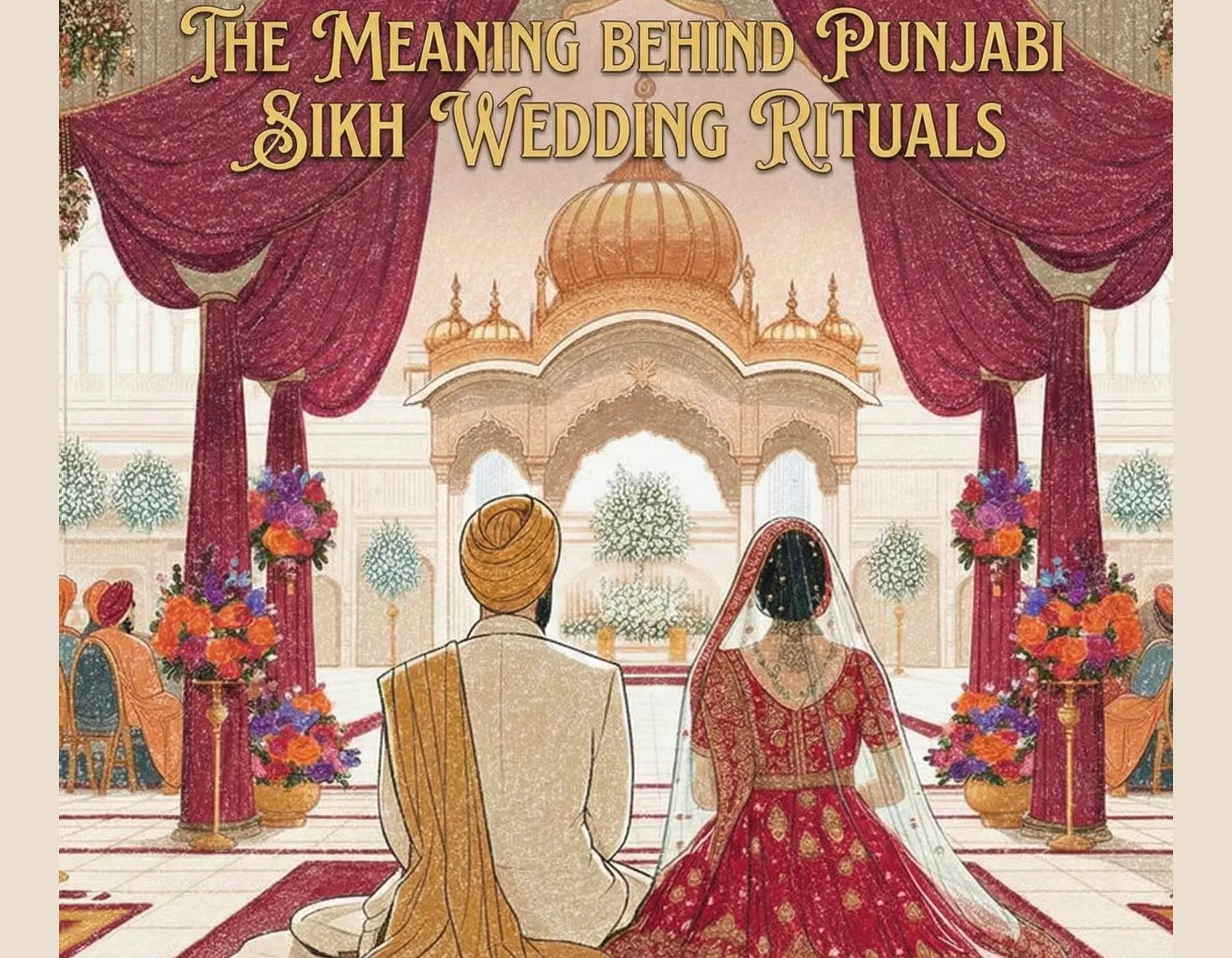
The heart of a Punjabi Sikh wedding lies in the Anand Karaj, which literally means “Ceremony of Bliss.” Held in the Gurdwara, this sacred ceremony is deeply spiritual, simple in structure, and profoundly meaningful. Strip away the decorations, the designer outfits, and the photography for a moment—and what remains is a humble union in the presence of the Guru.
Unlike many wedding traditions centered around elaborate rituals or symbolic objects, the Anand Karaj revolves entirely around the Guru Granth Sahib. The holy scripture is treated as the eternal Guru, the guiding light of Sikh life. The bride and groom sit side by side on the floor, facing the Guru, signifying equality and humility. No elevated thrones. No dramatic displays. Just devotion.
The ceremony begins with Kirtan (devotional singing), which creates a serene and reflective atmosphere. Then comes the central part of the Anand Karaj: the Laavan—the four sacred hymns composed by Guru Amar Das Ji. As each hymn is sung, the couple walks around the Guru Granth Sahib, with the groom leading and the bride holding onto a sash called the Palla. But here’s the key point—the groom is not leading as a superior. He symbolizes responsibility, while the bride’s hold on the Palla represents partnership and shared direction.
The Anand Karaj emphasizes that marriage is not a contract between two people alone—it is a covenant made in the presence of the Divine. There are no dramatic vows spoken aloud. The vows are embedded within the hymns themselves.
Think of the Anand Karaj as the spiritual anchor of the entire wedding. All the colorful celebrations orbit around this sacred core. Without it, the wedding loses its true essence.
Milni Ceremony: The Union of Two Families
Before the Anand Karaj formally begins, the Milni ceremony takes place. If you’ve ever seen it, you’ll recognize the warmth immediately. Representatives from both families line up to greet each other, exchange garlands, and embrace. It’s not just a polite introduction—it’s a symbolic merging.
The word Milni comes from “milna,” meaning “to meet.” But this isn’t just about meeting—it’s about accepting. Each key family member from the bride’s side greets their counterpart from the groom’s side. Fathers meet fathers, uncles meet uncles, brothers meet brothers. Garlands are exchanged as a sign of respect and equality.
Here’s what makes Milni so powerful: it levels the playing field. There is no sense of one family being superior to the other. Sikh teachings strongly reject hierarchy and ego. The Milni reflects this beautifully. Both families stand as equals, united by love and mutual respect.
Emotionally, this ceremony eases tension. Weddings can sometimes carry underlying anxieties—new relationships, new dynamics. Milni breaks the ice. A hug, a smile, a shared laugh—it sets the tone for harmony.
You can think of Milni as the handshake before a lifelong partnership. It says, “We trust you. We welcome you. We’re ready to walk this path together.”
Baraat Arrival: Joyful Procession with Purpose
The arrival of the groom, known as the Baraat, is often one of the most energetic moments of a Punjabi Sikh wedding. Traditionally, the groom arrives on a decorated horse, accompanied by family and friends dancing to the beat of the dhol. It’s loud, colorful, and filled with excitement.
But beyond the dancing lies symbolism. The groom’s journey to the Gurdwara represents his readiness to embrace responsibility. Historically, arriving on horseback symbolized courage and dignity. Today, whether on a horse or in a car, the underlying message remains: he is stepping forward to honor a sacred commitment.
The joyful dancing of the Baraat reflects collective happiness. Marriage isn’t a private affair—it’s a community celebration. The energy of the procession mirrors the optimism and hope surrounding the union.
When the Baraat reaches the Gurdwara, the tone shifts. Shoes are removed. Heads are covered. The lively celebration transitions into spiritual reverence. This contrast is meaningful—it reminds everyone that while joy is essential, humility before the Guru is paramount.
The Baraat is like a wave of energy that flows into calm waters. It begins with excitement and culminates in sacred devotion.
Palla Ceremony: A Symbol of Spiritual Guidance
During the Anand Karaj, one subtle yet significant ritual is the Palla ceremony. The bride’s father places one end of a scarf (the Palla) into the groom’s hands, and the bride holds onto the other end. This simple gesture carries profound symbolism.
It represents the bride’s family entrusting her to a new partnership—not as a transfer of ownership, but as a blessing for shared leadership. The groom holding the Palla symbolizes his commitment to guide the marriage in alignment with Sikh principles. The bride holding it signifies her equal participation and support.
Importantly, the Guru Granth Sahib remains at the center. The couple walks around the Guru—not around each other. This reinforces that spiritual wisdom, not individual ego, leads the marriage.
The Palla is like a thread weaving two lives together. It doesn’t bind tightly; it connects gently. It suggests unity without loss of individuality.
Laavan: The Four Sacred Rounds Explained
The Laavan are the spiritual heart of the Anand Karaj. Each of the four hymns describes a stage of spiritual and marital development. As the couple walks around the Guru Granth Sahib with each recitation, they symbolically commit to these stages.
Here’s a simplified breakdown:
| Lavaan | Spiritual Meaning | Marital Significance |
|---|---|---|
| First | Commitment to righteousness | Building a foundation based on faith |
| Second | Growing love through devotion | Deepening emotional connection |
| Third | Detachment from ego | Strengthening unity and trust |
| Fourth | Ultimate spiritual union | Experiencing divine bliss together |
The first round emphasizes living according to Dharma (righteous duty). The second speaks of cultivating love and harmony. The third focuses on overcoming ego—a crucial lesson in any marriage. The fourth celebrates spiritual unity and bliss.
Notice something beautiful here? The progression isn’t about material success. It’s about spiritual growth. Marriage, in Sikhism, becomes a path toward enlightenment.
The Laavan remind us that love isn’t static. It evolves, matures, and deepens through shared faith and understanding.
Anand Sahib and Ardaas: Collective Gratitude
After the Laavan, the congregation sings Anand Sahib, a hymn of joy and fulfillment. The atmosphere feels lighter, almost radiant. It’s as if everyone collectively exhales in gratitude.
Then comes the Ardaas—a final prayer seeking blessings for the newly married couple. The entire Sangat (congregation) stands together. This unity reinforces the idea that marriage is supported by community.
Gratitude lies at the center of this moment. Gratitude for love, for guidance, for divine grace. It’s a reminder that no marriage thrives alone—it flourishes within a supportive spiritual network.
Langar: The Sacred Meal of Equality and Service
After the Anand Karaj concludes, everyone gathers for Langar—the community meal served in the Gurdwara. At first glance, it may simply look like a shared lunch. But in reality, Langar is one of the most powerful expressions of Sikh philosophy, especially within the context of a wedding.
Langar represents equality in its purest form. Guests, regardless of social status, wealth, gender, or background, sit together on the floor in rows. There are no VIP tables. No reserved seating for “important” guests. Everyone eats the same simple, vegetarian meal. This practice, established by Guru Nanak Dev Ji and institutionalized by later Gurus, dismantles hierarchy and reinforces humility.
Think about how radical that is—even today. At a wedding, where extravagance often takes center stage, the most sacred meal is the simplest one. It sends a clear message: humility and service outweigh display and ego.
Langar is also powered by Seva—selfless service. Volunteers prepare the food, serve it, and clean up afterward without expectation of reward. During a wedding, family members often participate in this seva, symbolizing that marriage itself requires service, cooperation, and shared effort.
Spiritually, Langar grounds the celebration. After the emotional intensity of the ceremony, sitting together for a meal restores balance. It reminds the newlyweds that their life together should reflect generosity and inclusivity.
If marriage is a journey, Langar is the first shared step in community. It reinforces that the couple is not isolated—they are part of something bigger, supported by faith and fellowship.
Vidaai: The Emotional Farewell
Few moments in a Punjabi Sikh wedding are as emotionally powerful as the Vidaai. This is when the bride bids farewell to her parental home and leaves with her husband to begin a new chapter. Tears flow freely—not because it’s a loss, but because it’s a profound transition.
Vidaai symbolizes change, growth, and trust. The bride’s parents entrust her future to a new household, while she steps forward with courage and hope. It’s not about separation; it’s about expansion. Her world is growing larger.
Traditionally, the bride may throw handfuls of rice behind her as she leaves. This gesture represents gratitude and the wish for prosperity to remain in her parents’ home. It’s her way of saying, “Thank you for everything you’ve given me.”
Emotionally, Vidaai acknowledges that marriage reshapes relationships. The daughter who once relied on her parents now becomes a partner building her own family. Yet Sikh philosophy emphasizes that family bonds are never broken—they evolve.
Vidaai can feel like the closing of a cherished chapter in a book. But it’s also the turning of a page. The story doesn’t end—it deepens. The tears are mixed with smiles because everyone understands that this farewell is rooted in love and faith.
Welcoming the Bride: A New Beginning
When the bride arrives at her new home, she is welcomed warmly by her in-laws. This moment symbolizes acceptance and unity. The rituals may vary from family to family, but the meaning remains consistent: she is not an outsider—she is family.
Often, the groom’s mother performs a small welcoming ceremony, sometimes with a symbolic gesture like circling a tray or applying a mark on the bride’s forehead. These acts are blessings for prosperity and harmony.
Spiritually, this welcome reinforces equality and respect. Sikh teachings do not endorse the idea of a daughter-in-law as subordinate. Instead, she is to be treated with dignity and love. The household thrives when mutual respect exists among all members.
This moment is like planting a new seed in fertile soil. The environment must nurture it with kindness and patience. The bride, in turn, brings fresh energy, perspective, and love into her new home.
The welcoming ceremony reminds everyone that marriage isn’t about leaving one family behind—it’s about expanding the circle.
Modern Interpretations of Sikh Wedding Rituals
As times change, so do expressions of tradition. Punjabi Sikh weddings today may take place across the globe—from Amritsar to Toronto, from London to Melbourne. While the core spiritual elements remain intact, cultural adaptations are inevitable.
Many couples now blend traditional rituals with contemporary touches. Engagement parties may resemble Western-style celebrations. Wedding attire may include pastel lehengas or designer sherwanis. Sangeet nights can feel like full-scale concerts.
But here’s the important question: does modernization dilute the meaning?
Not necessarily. What truly matters is intention. As long as the Anand Karaj remains centered on Gurbani and equality, the essence of the wedding stays intact. Sikhism is a living faith—it adapts without losing its foundation.
In diaspora communities, weddings often become powerful expressions of cultural identity. They serve as reminders of heritage and faith in multicultural societies. For many young Sikhs, participating in these rituals strengthens their connection to their roots.
Modern couples are also more conscious about avoiding unnecessary extravagance or outdated customs that contradict Sikh principles, such as dowry practices. This return to authenticity reflects a deeper understanding of the faith.
Tradition and modernity don’t have to clash. They can coexist—like two melodies harmonizing in the same song.
The Deeper Meaning: Marriage as a Spiritual Partnership
When you strip away the music, the colors, the rituals, and even the emotion, what remains at the core of a Punjabi Sikh wedding? A spiritual partnership.
Sikh marriage is not about dominance, dependency, or societal expectation. It is about two individuals choosing to support each other’s spiritual evolution. The ultimate goal is not just happiness—it is union with Waheguru.
The Guru Granth Sahib consistently emphasizes conquering ego (haumai). And let’s be honest—marriage is one of life’s greatest teachers in overcoming ego. It demands patience, empathy, compromise, and humility.
Think of marriage as a shared pilgrimage. There will be smooth roads and rocky paths. But when both partners keep faith at the center, they navigate challenges with resilience.
The rituals—from Roka to Laavan—serve as reminders of these deeper truths. They are not empty customs. They are symbolic checkpoints on a lifelong spiritual journey.
In Sikhism, the ultimate love story is between the soul and the Divine. Marriage becomes a metaphor for that union. As the couple strengthens their bond with each other, they simultaneously deepen their connection with God.
That’s the real beauty behind Punjabi Sikh wedding rituals. They celebrate not just love—but enlightened love.
Conclusion
Punjabi Sikh wedding rituals are far more than vibrant celebrations filled with music and color. They are layered expressions of faith, equality, humility, and spiritual partnership. From the early blessings of the Roka to the sacred Laavan of the Anand Karaj, every ceremony carries intentional meaning.
At its heart, a Sikh wedding is about two souls choosing to walk together in remembrance of Waheguru. It is about building a life rooted in love, service, and shared growth. The rituals may evolve with time, but their spiritual essence remains constant.
When you witness a Punjabi Sikh wedding, you’re not just seeing a cultural event—you’re witnessing a sacred commitment guided by centuries of wisdom.
FAQs
1. What is the most important ritual in a Punjabi Sikh wedding?
The Anand Karaj is the most important ritual. It includes the Laavan, the four sacred hymns that define the spiritual foundation of marriage.
2. Why do Sikh couples walk around the Guru Granth Sahib?
They walk around the Guru Granth Sahib to symbolize that spiritual wisdom and divine guidance are at the center of their marriage.
3. Is dowry part of Sikh wedding traditions?
No. Sikh teachings reject dowry. Marriage is considered a spiritual partnership, not a financial transaction.
4. How long does a traditional Sikh wedding ceremony last?
The Anand Karaj ceremony itself typically lasts about one to two hours, though wedding celebrations may span several days.
5. Can Sikh weddings include modern elements?
Yes. Cultural adaptations are common, but the core spiritual elements—especially the Anand Karaj—remain essential.