The Hidden Symbolism in Phulkari Patterns You Never Knew About
The Origins of Phulkari: Threads of History and Heritage
Phulkari is not just embroidery—it is memory stitched into cloth. Originating in the Punjab region of India and Pakistan, Phulkari, which literally means “flower work,” dates back to at least the 15th century. But here’s the thing: it wasn’t created for fashion shows or luxury boutiques. It was born inside homes, crafted by women who poured their emotions, dreams, and beliefs into every thread.
Imagine a time before text messages, before diaries, before social media. How did women express their hopes or document important life moments? Through Phulkari. Mothers and grandmothers embroidered shawls and dupattas for their daughters’ weddings, often starting years in advance. Each stitch was intentional. Each pattern whispered something meaningful.
Traditionally, Phulkari was embroidered on coarse hand-spun cotton cloth called “khaddar,” using brightly colored silk threads known as “pat.” What makes it fascinating is that the embroidery was done from the reverse side of the fabric. The artist couldn’t see the final design directly while stitching. It required imagination, precision, and extraordinary skill. Isn’t that poetic? Creating beauty without seeing it fully form.
Phulkari was more than decoration—it marked milestones. Births, weddings, festivals—every major event had a specific style of Phulkari associated with it. It was part of a woman’s trousseau, a symbol of family honor, and even a reflection of agricultural prosperity.
Over centuries, invasions, partition, and modernization threatened this art form. Yet it survived. Why? Because it was woven into identity. Phulkari wasn’t just fabric; it was heritage. And within that heritage lies a world of hidden symbolism that most people overlook today.
Let’s unravel those meanings, one thread at a time.
What Makes Phulkari Unique? Understanding Its Artistic Foundation
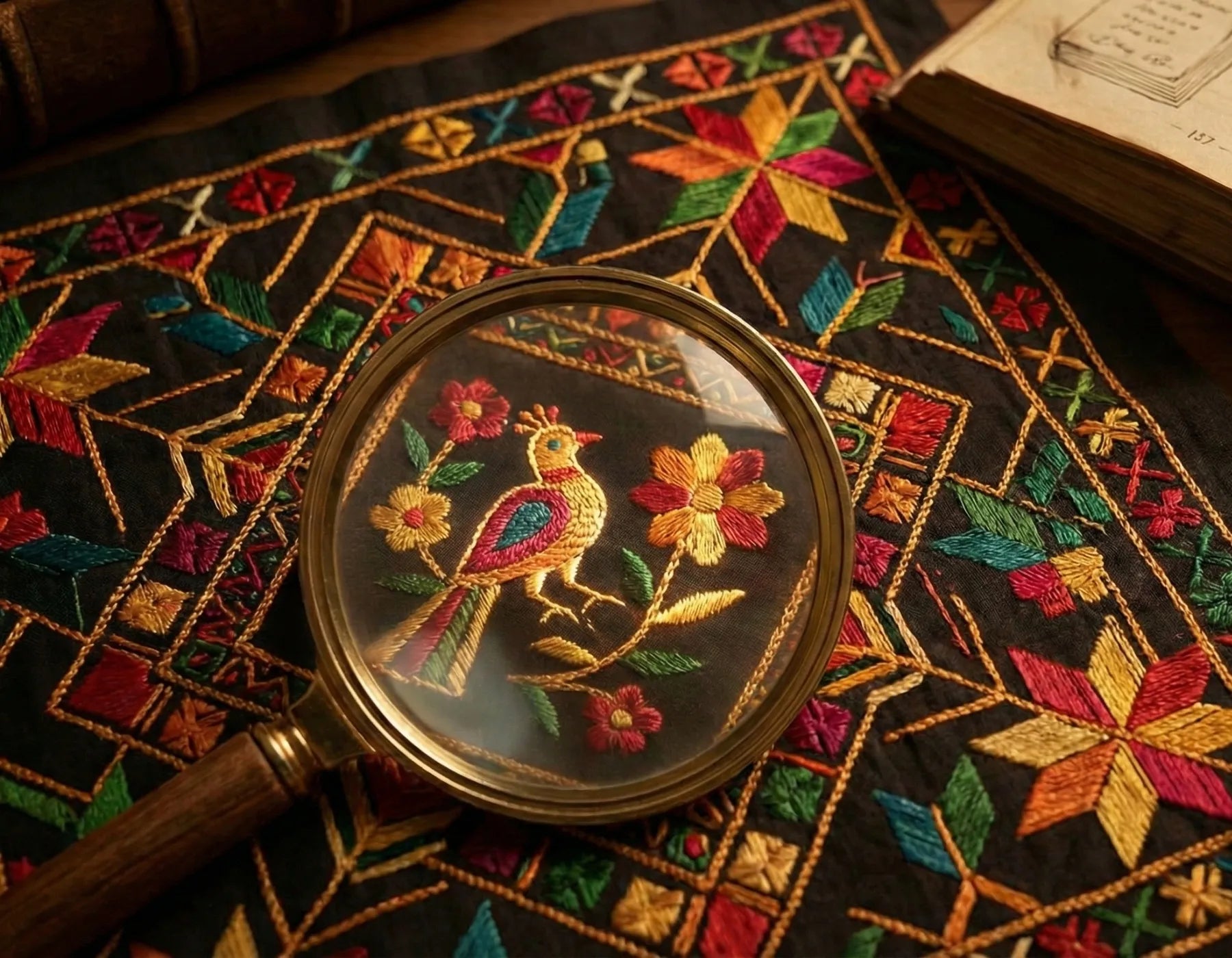
At first glance, Phulkari might look like vibrant geometric embroidery. Bright oranges, deep reds, golden yellows—almost like a field of marigolds dancing in sunlight. But if you look closer, you’ll notice something deeper. Phulkari is not random decoration. It’s structured storytelling.
Unlike many embroidery styles that focus on surface embellishment, Phulkari uses a distinctive darning stitch technique. The patterns are created using long and short stitches that form intricate motifs when viewed from the front. The reverse stitching technique gives it a textured, almost glowing appearance. The silk threads catch light beautifully, making the fabric shimmer as it moves.
But what truly sets Phulkari apart is its intentional symbolism. The designs weren’t drawn beforehand. They lived in the memory of the women who stitched them. Patterns were passed down orally and visually—from grandmother to mother to daughter. This made every piece deeply personal yet culturally connected.
Another unique aspect? Imperfection was embraced. Unlike machine-made symmetry, traditional Phulkari pieces often have slight variations. A flower might not be perfectly aligned. A border might shift subtly. But that’s the beauty of it. It reflects the human hand. It reflects life—messy, unpredictable, yet beautiful.
Phulkari also differs in density. Some pieces, like Bagh, are so densely embroidered that the base fabric is almost completely covered. Others are more spaced out, allowing the background cloth to breathe. This density wasn’t random—it carried meaning, which we’ll explore soon.
When you hold a traditional Phulkari dupatta, you’re not just holding a textile. You’re holding months, sometimes years, of dedication. You’re holding whispered prayers, silent hopes, and cultural codes woven so cleverly that many modern eyes fail to see them.
And that’s where the hidden symbolism begins.
The Language of Threads: How Symbolism Is Woven Into Fabric
Have you ever thought about how fabric can speak? Phulkari does exactly that. It communicates without words. Every motif, every color, every layout carries a message. It’s like a secret language stitched in silk.
In traditional Punjabi culture, literacy among women wasn’t always common. But artistic literacy? That was abundant. Women used embroidery as a non-verbal diary. Through patterns, they expressed joy, longing, faith, humor, and even quiet rebellion.
For example:
-
A densely embroidered shawl often symbolized prosperity and wealth.
-
Specific motifs indicated fertility or blessings for children.
-
Certain patterns were exclusively made for brides.
-
Some designs reflected daily village life, preserving social history.
Think of Phulkari as a coded letter. Only those within the culture fully understood its meaning. A bride receiving a Chope from her grandmother wasn’t just receiving a shawl. She was receiving blessings stitched into geometric harmony.
Even spacing mattered. A wide-open design could symbolize freedom or openness. A tightly packed pattern might represent abundance or protection. The repetition of motifs created rhythm, almost like poetry in visual form.
What’s remarkable is how intuitive this symbolism was. Women didn’t need formal training. They absorbed meanings through observation and participation. It was community knowledge, living and breathing through shared creativity.
In today’s world, we often buy embroidered pieces without knowing what they represent. We admire the colors, maybe the craftsmanship—but we miss the message. That’s like listening to music without hearing the lyrics.
Phulkari patterns are lyrics. They tell stories of harvests, marriages, spirituality, love, and resilience. Once you understand this language of threads, you’ll never look at a Phulkari the same way again.
And now, let’s step into specific patterns and decode their hidden symbolism.
Bagh Phulkari: The Garden of Prosperity
“Bagh” literally means “garden.” But in Phulkari, it means much more than blooming flowers. A Bagh Phulkari is so densely embroidered that the base fabric is almost invisible. The entire surface becomes a radiant tapestry of silk threads. Why such fullness? Because it symbolizes abundance—both material and spiritual.
Traditionally, Bagh Phulkari was associated with wealth and celebration. It was often worn during significant occasions like weddings. When a bride draped herself in a Bagh, she wasn’t just showcasing beauty. She was embodying prosperity. The heavy embroidery represented a life filled with richness, fertility, and blessings.
There are different types of Bagh designs, each with its own subtle meaning:
-
Vari-da-Bagh: Gifted by in-laws to welcome the bride.
-
Ghunghat Bagh: Worn over the head, symbolizing modesty and honor.
-
Bawan Bagh: Featuring 52 different patterns, reflecting diversity and complexity of life.
The “garden” metaphor is powerful. A garden thrives with care, patience, and nourishment—just like a family. By covering the entire cloth with intricate designs, women symbolized their wish for a life overflowing with joy and stability.
The color palette also played a role. Deep reds and maroons were common base fabrics, symbolizing marriage and passion. Golden yellow threads hinted at harvest and sunlight—prosperity earned through hard work.
Imagine spending months stitching a Bagh for your daughter’s wedding. Every stitch becomes a prayer. Every motif becomes a wish. It’s not just art—it’s love in its most tangible form.
When you see a Bagh Phulkari today displayed in museums or fashion collections, remember: it’s not merely decorative. It’s a garden of hopes, carefully cultivated with silk and devotion.
Chope Phulkari: A Grandmother’s Blessing in Red
If Bagh is about abundance, Chope is about blessings. Traditionally gifted by a maternal grandmother to her granddaughter before marriage, the Chope Phulkari carries emotional weight that’s hard to put into words. It’s usually embroidered on a deep red or maroon base cloth—colors deeply associated with marriage, fertility, and sacred beginnings in Punjabi culture.
Unlike the densely embroidered Bagh, Chope has a more structured and linear pattern. The designs are typically symmetrical, featuring small geometric motifs arranged in horizontal and vertical lines. The border is often heavily emphasized, symbolizing protection. Think of it as a warm embrace stitched into fabric—firm, reassuring, and full of love.
Why the grandmother? In many Punjabi households, the maternal grandmother held a special role in preparing a girl for married life. The Chope wasn’t just a gift; it was a rite of passage. It was embroidered during quiet afternoons, perhaps while sharing stories about love, resilience, and family responsibilities. Each stitch carried wisdom.
The symbolism in Chope is subtle but powerful:
-
Repetitive geometric motifs: Stability and balance in married life
-
Strong borders: Protection from negativity
-
Red base color: Prosperity, passion, and sacred commitment
There’s something incredibly touching about this tradition. Imagine a grandmother, eyes slightly strained but heart full, carefully counting threads to maintain symmetry. She may not say everything out loud, but her hopes for her granddaughter are woven clearly into the cloth.
In a way, Chope Phulkari acts like a silent letter—one that says, “May your marriage be steady. May your home be secure. May your life be full of warmth.”
Today, Chope designs are replicated in fashion markets, often stripped of their deeper meaning. But if you look beyond the surface, you’ll realize you’re looking at generations of maternal love carefully preserved in silk.
Suber Phulkari: Celebrating New Beginnings
“Suber” refers to the ceremonial moment when a bride prepares to step into her new life. Suber Phulkari is often worn during the morning rituals of marriage, symbolizing dawn—not just of a day, but of a new chapter.
Morning carries powerful symbolism across cultures. It represents hope, renewal, and fresh starts. In Phulkari, Suber designs reflect this idea through lighter patterns and bright, optimistic color combinations. Yellows, oranges, and softer reds are common, echoing the colors of sunrise.
Unlike Bagh, Suber is less dense, allowing the base fabric to show through. This openness is symbolic. It reflects vulnerability and possibility—the idea that life is not fully written yet. There is space for experiences, growth, and surprises.
Key symbolic elements often include:
-
Radiating motifs: Energy and forward movement
-
Open spacing: Freedom and opportunity
-
Bright threads on red cloth: Joy emerging from tradition
There’s poetry in this. A bride wrapped in Suber is like the first light breaking through darkness. She carries both nervousness and excitement. The embroidery mirrors that emotional blend—structured yet open.
Phulkari, in this context, becomes deeply psychological. It doesn’t just represent cultural values; it reflects human emotions. The careful choice of lighter density and brighter threads suggests hope outweighing fear.
Modern brides may not always know they’re wearing Suber-inspired designs, but the symbolism remains. When you see these vibrant yet breathable patterns, you’re witnessing a celebration of beginnings.
And isn’t that something we all relate to? We’ve all stood at the edge of something new—heart racing, mind hopeful. Suber Phulkari captures that universal feeling in silk.
Sainchi Phulkari: Stories of Rural Life
Now here’s where things get truly fascinating. Sainchi Phulkari breaks away from strict geometry and dives into storytelling. Unlike other types that focus on abstract or floral motifs, Sainchi features figurative designs—people, animals, daily village activities. It’s like a visual diary of Punjabi rural life.
You might see:
-
Women churning butter
-
Farmers plowing fields
-
Brides riding in palanquins
-
Peacocks dancing
-
Cattle grazing
These aren’t random decorations. They’re snapshots of reality. Sainchi literally preserves history. In a time when photography was rare and literacy limited, embroidery became documentation.
The symbolism here lies in representation. By stitching scenes of daily life, women acknowledged their world—their labor, their joys, their social structure. It was subtle empowerment. They were saying, “Our lives matter enough to be recorded.”
There’s also humor and playfulness in Sainchi designs. Sometimes exaggerated figures or whimsical animals appear, adding personality to the piece. It reminds us that Phulkari wasn’t always solemn; it could be lively and expressive.
The use of multiple colors in Sainchi also reflects diversity and vibrancy. Unlike more formal wedding Phulkaris, these pieces often felt personal and relaxed. They might not have been reserved solely for ceremonies but for everyday wear during festivals.
Sainchi teaches us something important: Phulkari wasn’t just about abstract blessings. It was about lived experiences. It honored the ordinary moments—the grinding of wheat, the gathering of women, the rhythm of village life.
Today, Sainchi pieces are rare and highly valued because they offer a window into the past. When you examine one closely, you’re not just admiring embroidery. You’re reading a centuries-old storybook written in thread.
And perhaps that’s the most beautiful symbolism of all—preserving life itself in art.
Mor (Peacock) Motifs: Grace, Beauty, and Romance
The peacock, or “Mor,” is one of the most recognizable motifs in Phulkari. But it’s not included simply because it looks beautiful. In Punjabi culture—and Indian symbolism more broadly—the peacock represents grace, love, pride, and romantic longing.
Peacocks are often associated with the monsoon season, which symbolizes renewal and fertility. Their elaborate feathers and courtship dances naturally evoke ideas of attraction and celebration. So when a peacock appears in Phulkari, especially in pieces prepared for brides, it carries a romantic undertone.
Symbolically, the Mor can represent:
-
Feminine beauty and elegance
-
Love and longing
-
Joy during the rainy (fertile) season
-
Spiritual awakening
Interestingly, the peacock also has spiritual associations. In some traditions, it symbolizes immortality and protection. Its feathers are believed to ward off negative energy. So including a Mor motif wasn’t just about aesthetics—it added a layer of spiritual safeguarding.
In embroidery, the peacock is often stylized rather than realistic. Angular lines form its body, and geometric shapes create its feathers. This abstraction keeps it aligned with Phulkari’s broader design language while preserving its symbolic identity.
Imagine a bride wearing a dupatta with delicate Mor patterns scattered across it. It’s as if the fabric itself is whispering, “May your marriage be filled with grace and affection.”
Even today, peacock motifs dominate Indian fashion. But when you spot one on a Phulkari piece, remember—it’s not just decoration. It’s a symbol of beauty blossoming, of love unfolding, and of life dancing proudly under open skies.
Wheat and Agricultural Patterns: Abundance and Fertility
Punjab has long been known as the “Granary of India.” Endless golden wheat fields, swaying under the sun, define its landscape. So it’s no surprise that agricultural motifs—especially wheat stalks—found their way into Phulkari embroidery. But these weren’t just representations of scenery. They were powerful symbols of life itself.
Wheat patterns in Phulkari often appear as elongated, repetitive motifs arranged in rows. At first glance, they might look like simple geometric shapes. But to the women stitching them, they symbolized sustenance, prosperity, and fertility. Wheat meant food on the table. It meant survival. It meant stability.
Think about it—when your entire community depends on harvest cycles, agriculture isn’t just an occupation. It’s identity. Embroidering wheat onto a bride’s shawl was like saying, “May your home always be abundant. May your fields never run dry.”
These motifs often appeared in:
-
Wedding Phulkaris, to bless the couple with prosperity
-
Festival garments worn during harvest celebrations
-
Everyday shawls reflecting gratitude for the land
There’s also a deeper layer of symbolism. Just as seeds are sown and later bloom into crops, marriage was seen as the beginning of a new lineage. Wheat, therefore, also represented fertility and continuation of family lines.
The repetitive nature of wheat designs mirrors the rhythm of farming life—planting, harvesting, repeating. It’s cyclical. It reflects the idea that life moves in seasons. Good times follow hard times, just as harvest follows sowing.
Even today, when agriculture may not dominate every household, wheat remains a proud emblem of Punjabi heritage. When you notice those golden thread patterns running across a Phulkari dupatta, you’re looking at more than decoration. You’re seeing gratitude for the earth, respect for labor, and a heartfelt wish for abundance.
It’s amazing how something as simple as a grain can carry so much meaning when stitched with intention.
Geometric Shapes: Protection and Spiritual Balance
If you examine a traditional Phulkari closely, you’ll notice a heavy reliance on geometric forms—diamonds, triangles, squares, and chevrons. At first, they might seem like purely aesthetic choices. But in reality, geometry in Phulkari carries deep spiritual symbolism.
In many ancient cultures, geometric shapes were believed to hold protective energy. Symmetry symbolized balance. Repetition created harmony. In Punjabi embroidery traditions, these shapes weren’t random—they were deliberate shields against negativity.
For example:
-
Diamond shapes (often called “chauburja”): Represent protection and the four corners of a home
-
Triangles: Symbolize strength and upward growth
-
Squares: Stability and groundedness
-
Repeating patterns: Continuity and eternal cycles
The strong borders you often see in Phulkari are especially symbolic. They frame the central design, acting almost like a protective wall. It’s as if the embroidery is guarding the wearer from unseen forces.
There’s something fascinating about how these shapes come together. Individually, they’re simple. But when stitched repeatedly, they create intricate, mesmerizing designs. It’s a reminder that small, consistent efforts build something powerful—much like life itself.
Geometric Phulkari designs also reflect mental discipline. Remember, these patterns were created without printed templates. Women counted threads meticulously, maintaining symmetry from memory. It required focus, patience, and precision.
Symbolically, this precision mirrored the values expected in family life—balance, harmony, and structure. A chaotic design would disrupt the spiritual message. So symmetry wasn’t just about beauty; it was about meaning.
When you see those radiant diamonds and sharp lines glistening in silk, think of them as protective mantras—visual prayers repeating themselves across fabric.
It’s proof that even the simplest shapes can hold profound significance when woven with intention.
Colors in Phulkari: More Than Just Aesthetic Choices
Color in Phulkari is never accidental. Each shade carries emotional, cultural, and spiritual weight. The most traditional base fabric is deep red or maroon. Why? Because red symbolizes marriage, passion, strength, and sacredness in Punjabi culture. It’s bold. It commands attention. It represents life force.
But the story doesn’t stop there. The silk threads—often in bright yellows, oranges, pinks, greens, and blues—add layers of symbolism.
Here’s what some common colors represent:
-
Yellow/Golden: Harvest, prosperity, divine blessings
-
Orange: Energy, warmth, spirituality
-
Green: Growth, fertility, nature
-
White: Purity and peace
-
Pink: Joy and celebration
The contrast between the dark base and vibrant threads creates a glowing effect. It’s almost as if light is emerging from within the fabric. Symbolically, that glow represents hope shining through life’s challenges.
Color combinations also mattered. A heavily golden Bagh on red fabric symbolized overflowing prosperity. A mix of green and yellow hinted at fertile land and healthy crops. The emotional tone of the garment shifted depending on these combinations.
Interestingly, traditional Phulkari rarely used black as a dominant color. Brightness was preferred, reflecting optimism and vibrancy of village life. The embroidery wasn’t meant to be subtle—it was meant to celebrate.
Think of color in Phulkari like music in a film scene. It sets the mood. It amplifies the message. Without understanding color symbolism, you’re only seeing half the story.
Next time you see a vivid Phulkari dupatta glowing in sunlight, pause for a moment. Ask yourself: What story are these colors telling? Chances are, it’s one of joy, abundance, and unwavering hope.
The Role of Phulkari in Weddings and Rituals
In Punjabi culture, weddings are grand, emotional, and deeply symbolic events. Phulkari plays a central role in these ceremonies—not as mere decoration, but as a sacred textile carrying blessings across generations.
Different types of Phulkari were designated for specific rituals. The Chope was gifted before marriage. The Suber was worn during wedding mornings. The Bagh might be draped during important ceremonial moments. Each piece had a purpose.
Why such importance? Because marriage wasn’t just a union of two individuals—it was a merging of families, traditions, and futures. Phulkari embodied that merging.
During wedding rituals:
-
The bride often covered her head with Phulkari as a sign of respect.
-
Elders gifted embroidered shawls as tokens of blessing.
-
Certain patterns symbolized fertility and prosperity for the new couple.
The act of wearing Phulkari during rituals transformed it into something sacred. It wasn’t just fabric touching skin; it was heritage enveloping the bride.
There’s also emotional symbolism. Imagine walking toward a new life wrapped in something your grandmother stitched by hand. It’s comforting. It’s grounding. It’s like carrying your roots with you wherever you go.
Phulkari also reinforced social bonds. The gifting process created connections between maternal and marital families. It was both personal and communal.
Today, modern bridal fashion may include designer lehengas and contemporary silhouettes. Yet Phulkari still finds its place—sometimes as a dupatta, sometimes incorporated into wedding décor. Why? Because its symbolism is timeless.
Weddings may evolve, but the desire for blessings, protection, and prosperity remains constant. And Phulkari continues to deliver those wishes—quietly, beautifully, and powerfully.
Hidden Feminine Voices: Phulkari as Silent Storytelling
Here’s something truly profound: Phulkari gave women a voice in a time when their spoken voices were often limited. Through embroidery, they expressed identity, creativity, and even subtle resistance.
Women didn’t sign their names on Phulkari pieces. Their recognition wasn’t public. Yet their individuality shone through design choices. Slight variations in motifs, color preferences, and layout reflected personal style.
Sainchi Phulkari, especially, captured scenes of women working, celebrating, and socializing. It acknowledged their daily contributions. In a way, embroidery became documentation of female experience.
Phulkari also allowed emotional expression. Joy over a child’s birth. Anxiety about a daughter’s marriage. Hope for good harvests. All of it could be stitched into patterns.
There’s a quiet strength in that. When direct expression isn’t always possible, creativity becomes a powerful outlet. Thread becomes language.
Even today, when we admire antique Phulkari in museums, we rarely know the name of the woman who created it. But her voice is there—in every carefully counted stitch.
Isn’t that incredible? Art outliving anonymity.
Phulkari stands as evidence that women have always been storytellers, historians, and artists—even if history books didn’t always credit them.
And perhaps that’s one of its most beautiful hidden symbols: resilience woven softly yet permanently into cloth.
Phulkari in Modern Fashion: Revival Without Losing Meaning
Walk into any contemporary fashion boutique in India—or even browse international designer collections—and chances are, you’ll spot Phulkari somewhere. Maybe it’s a cropped jacket paired with jeans. Maybe it’s a runway lehenga with bold floral panels. Maybe it’s even stitched onto handbags or footwear. Phulkari has made a dramatic comeback. But here’s the real question: has its meaning survived the revival?
The resurgence of Phulkari began as part of a broader movement to celebrate indigenous crafts. Designers started collaborating with rural artisans, bringing traditional techniques into modern silhouettes. Suddenly, what was once confined to village trunks became global couture.
On the surface, this seems like a beautiful success story. And in many ways, it is. Artisans gain visibility. Craft traditions get financial support. Younger generations rediscover their heritage. But symbolism can sometimes get diluted when tradition meets trend.
For example:
-
Bagh-inspired dense embroidery is now used on bridal lehengas purely for aesthetic richness.
-
Sainchi storytelling motifs appear on jackets without explaining their rural narratives.
-
Geometric protective patterns are replicated without acknowledgment of their spiritual undertones.
Does that mean the meaning is lost? Not necessarily. It just means the responsibility shifts to us—to learn, to respect, to preserve context.
Interestingly, many modern designers are consciously trying to revive not just the craft, but the story behind it. Some include tags explaining motifs. Others work directly with artisan communities, ensuring authenticity isn’t compromised.
There’s something powerful about seeing a centuries-old embroidery technique walking down a global runway. It’s proof that heritage isn’t static—it evolves. But evolution shouldn’t erase roots.
When you wear a modern Phulkari piece, you’re not just wearing embroidery. You’re wearing history, resilience, and cultural memory. The key is awareness. If fashion is the surface, symbolism is the soul.
And true revival happens when both stay connected.
Why Understanding Phulkari Symbolism Matters Today
You might wonder—why dig so deep into embroidery? Isn’t it enough to admire its beauty?
Well, think about it this way. Imagine reading a book in a language you don’t understand. You’d see the letters, but you’d miss the story. That’s what happens when we look at Phulkari without understanding its symbolism.
In today’s fast-paced world, handmade crafts are often reduced to commodities. We buy, we wear, we move on. But traditional textiles like Phulkari carry layers of meaning that deserve recognition.
Understanding its symbolism matters because:
-
It preserves cultural identity. When we understand the stories behind motifs, we keep traditions alive.
-
It honors artisans. Recognizing meaning gives credit to the creativity and emotional labor of generations of women.
-
It deepens appreciation. Beauty feels richer when you know what it represents.
-
It connects past and present. Symbolism bridges generational gaps.
Phulkari is more than thread and fabric—it’s anthropology, sociology, psychology, and art combined. It tells us about agricultural economies, marriage systems, gender roles, spiritual beliefs, and emotional expression.
And here’s something even more relevant: in a world increasingly dominated by machine production, Phulkari reminds us of patience. Each stitch once took time. Care. Attention. There’s a lesson there about slowing down and valuing process over instant results.
When we understand symbolism, we move from being consumers to being custodians of culture. We carry forward stories rather than just styles.
So the next time you see Phulkari—whether in a museum, a wedding, or a fashion store—pause for a moment. Look beyond the colors. Ask what it’s saying.
You might be surprised at how loudly threads can speak.
Conclusion
Phulkari is not just embroidery—it is emotion stitched into time. From the abundance symbolized in Bagh to the grandmother’s blessings in Chope, from the hopeful dawn of Suber to the storytelling charm of Sainchi, every pattern carries a message. Wheat motifs whisper prosperity. Geometric shapes guard with silent strength. Peacocks dance with romance. Colors glow with layered meaning.
What makes Phulkari extraordinary isn’t just its visual brilliance—it’s its depth. It emerged from the hands of women who transformed everyday fabric into sacred narrative. Without formal education in art theory, they created a complex symbolic language that still resonates centuries later.
In modern fashion, Phulkari continues to evolve. Yet its true power lies in understanding. When we recognize the symbolism, we don’t just admire craftsmanship—we honor heritage.
Threads may seem delicate, but together they create something enduring. And that’s exactly what Phulkari represents: resilience, love, and cultural memory woven so tightly that time itself struggles to unravel it.
FAQs
1. What does Phulkari literally mean?
Phulkari translates to “flower work.” It comes from the Punjabi words “phul” (flower) and “kari” (work), referring to the floral embroidery style traditionally done on shawls and dupattas.
2. Is Phulkari only worn during weddings?
No. While it plays a major role in weddings and rituals, Phulkari was also worn during festivals, harvest celebrations, and other important life events. Some styles were even used in daily life.
3. What is the difference between Phulkari and Bagh?
Phulkari refers broadly to the embroidery style, while Bagh is a specific type of Phulkari where the fabric is almost completely covered with dense embroidery, symbolizing abundance.
4. Why is red commonly used in Phulkari?
Red symbolizes marriage, passion, prosperity, and sacredness in Punjabi culture. It is traditionally associated with brides and significant life ceremonies.
5. Is traditional Phulkari still handmade today?
Yes, although machine-made versions exist, many artisans in Punjab continue to create authentic handmade Phulkari using traditional techniques passed down through generations.