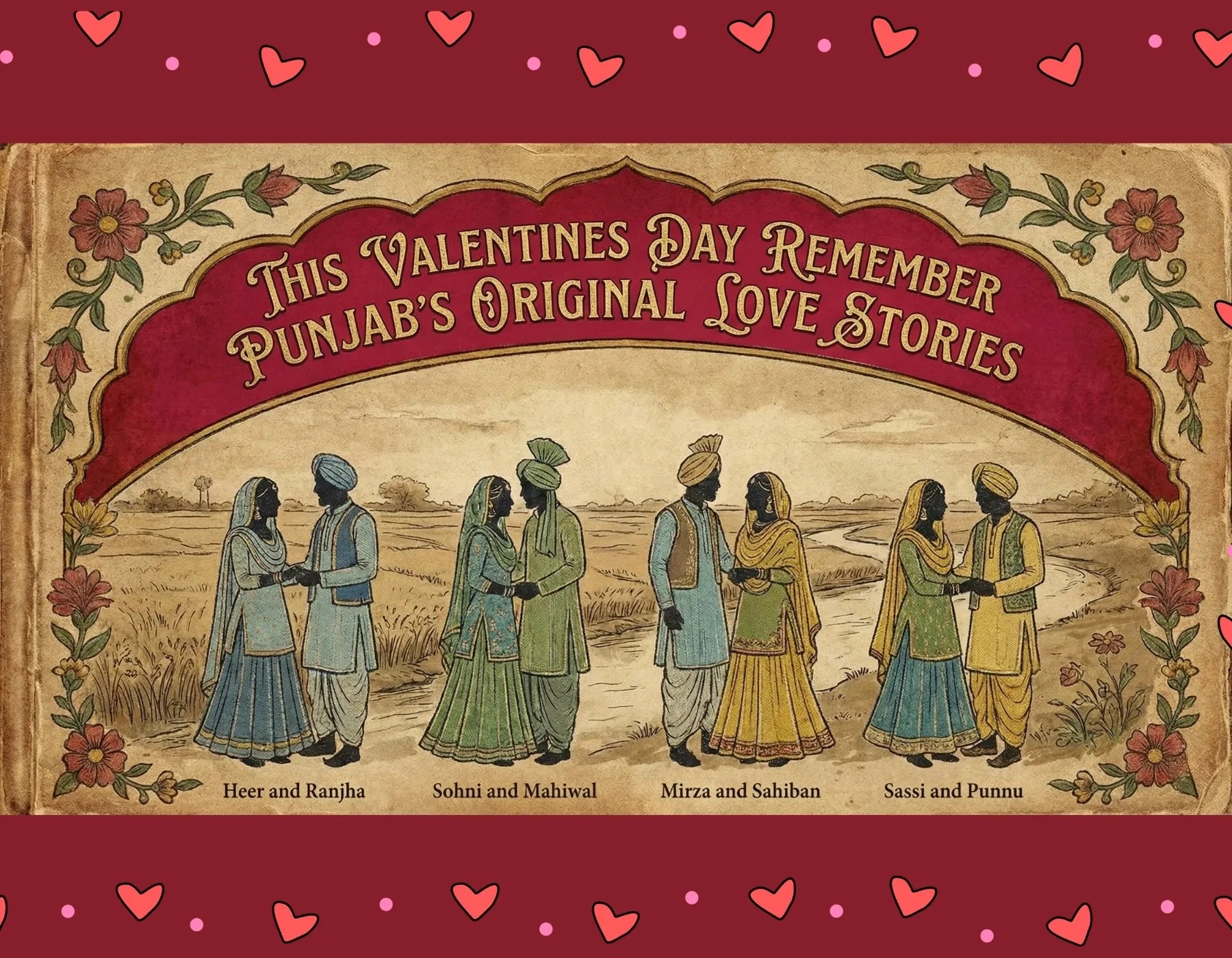
This Valentine’s Day, Remember Punjab’s Original Love Stories
Introduction: Beyond Roses and Chocolates
The Forgotten Depth of Punjabi Romance
Valentine’s Day has become predictable, hasn’t it? Red roses, heart-shaped balloons, candlelight dinners, and carefully filtered Instagram posts. There’s nothing wrong with celebrating love in sweet, simple ways. But somewhere between the chocolate boxes and online gift deliveries, we’ve forgotten that love is not just about grand gestures—it’s about depth, sacrifice, rebellion, and sometimes, heartbreak. And if there’s one land that understands love in its rawest, most fearless form, it’s Punjab.
Punjab’s original love stories are not just tales whispered in the dark; they are woven into the soil, sung in folk songs, and echoed in the rhythm of the dhol. These are stories where love was not convenient. It was dangerous. It challenged families, social norms, class divisions, and even fate itself. Lovers didn’t just text each other in secrecy—they crossed rivers at midnight, wandered through deserts barefoot, and stood against entire clans for the sake of their beloved.
Think about that for a moment. How often do we measure love by comfort today? In Punjab’s folklore, love wasn’t about comfort. It was about conviction. It was about choosing someone even when the world turned its back on you.
This Valentine’s Day, instead of just celebrating surface-level romance, why not remember the love stories that defined devotion? The ones that remind us love is not fragile—it’s fierce. These legends are more than entertainment; they are cultural mirrors reflecting passion, resilience, and spiritual depth. And once you revisit them, your idea of love might never feel the same again.
Why These Stories Still Matter Today
You might wonder—why revisit centuries-old tales in a world ruled by dating apps and instant connections? Because the human heart hasn’t changed as much as technology has. We still long to be understood. We still crave loyalty. We still fear losing the one person who makes life feel meaningful.
Punjab’s love stories endure because they speak to something timeless inside us. They aren’t polished fairy tales with guaranteed happy endings. Most of them are tragic. But that tragedy is what makes them powerful. It shows that love isn’t always rewarded with comfort—it’s tested by struggle.
In a society that often prioritizes status, wealth, and reputation, these stories dared to say something radical: love is worth more. They questioned rigid traditions. They exposed hypocrisy. They gave voice to women who refused to remain silent. They highlighted men who valued love over pride.
And here’s the deeper layer—many of these stories are infused with Sufi philosophy. On the surface, they are romantic tales. But underneath, they represent the soul’s longing for union with the Divine. Separation becomes symbolic. Pain becomes purification. Love becomes sacred.
So when you remember Heer and Ranjha or Sohni and Mahiwal, you’re not just recalling a romantic tragedy. You’re engaging with cultural wisdom that has survived invasions, borders, and generations.
This Valentine’s Day, let’s move beyond commercial romance. Let’s rediscover love that was bold enough to shake the world.
The Cultural Heartbeat of Punjab
Love as Resistance and Devotion
Punjab has always been a land of intensity. Its fields are golden, its music is loud, its food is rich, and its emotions? Even richer. Love in Punjab is not shy or hidden. It’s expressive. It’s sung out loud. It’s carved into poetry.
But here’s what makes Punjabi love stories different—they are acts of resistance.
When Heer chose Ranjha, she wasn’t just choosing a man; she was defying her family’s authority. When Sohni swam across the river to meet Mahiwal, she wasn’t just risking her life; she was rejecting a forced marriage. Love, in these stories, becomes rebellion against unjust systems.
Imagine living in a society where family honor outweighs personal happiness. Where marriage is decided by alliances, not affection. Choosing love under such conditions wasn’t romantic fantasy—it was revolution.
Yet these stories never portray love as selfish. It’s not about running away for pleasure. It’s about devotion. It’s about a connection so profound that living without it feels meaningless.
That’s why Punjabi folklore treats lovers almost like saints. Their suffering isn’t seen as weakness. It’s seen as proof of sincerity. Love becomes a test of character. Are you willing to endure humiliation? Exile? Death?
This depth transforms romance into something sacred. It’s no longer about butterflies in your stomach—it’s about fire in your soul.
The Role of Folklore, Music, and Poetry
If you walk into a Punjabi gathering—even today—you’ll hear echoes of these stories. In wedding songs. In qawwalis. In Sufi performances. They live on through rhythm and rhyme.
Waris Shah’s “Heer” is not just a poem; it’s a masterpiece of Punjabi literature. Bulleh Shah and Shah Hussain infused romantic imagery with spiritual symbolism. Folk singers keep these tales alive, ensuring that every generation knows the names of these legendary lovers.
Why poetry? Because ordinary language isn’t enough to express extraordinary love. Metaphors become necessary. The river isn’t just water—it’s separation. The desert isn’t just sand—it’s trial. The night isn’t just darkness—it’s longing.
Music carries emotion in a way logic never can. That’s why these stories survived centuries before printing presses were common. They were sung. Memorized. Passed down like heirlooms.
Even modern Punjabi cinema continues to revisit these legends. Each retelling adds a layer but preserves the core—love that refuses to surrender.
So this Valentine’s Day, maybe instead of a playlist filled only with modern love songs, add a Sufi kalaam. Listen closely. You’ll hear longing, surrender, rebellion, and devotion all in one breath.
And suddenly, love won’t feel small anymore.
Heer and Ranjha: The Eternal Lovers
The First Meeting and Blossoming Love
Every culture has that one love story—the one that defines romance itself. For Punjab, that story is Heer and Ranjha. Their names are spoken together, almost as if separating them would break a sacred rule.
Ranjha, the youngest of four brothers, was carefree and deeply sensitive. Unlike his siblings, he had little interest in farming. After conflicts at home, he left his village, wandering until he reached Heer’s land. Tired and hungry, he rested under a tree in her family’s fields. That moment—simple and ordinary—changed everything.
Heer saw him playing the flute. And something shifted.
It wasn’t just attraction. It was recognition. As if their souls had known each other long before their eyes met.
Ranjha began working as a caretaker of Heer’s family cattle, just to stay near her. Their love grew quietly, in stolen glances and secret meetings. The fields became their refuge. The flute became their language.
But love rarely stays hidden for long.
When Heer’s family discovered the affair, all hell broke loose. Honor was threatened. Reputation was at stake. Ranjha was thrown out, humiliated and heartbroken. Heer was forced into marriage with another man.
Here’s where their story deepens. Ranjha didn’t just mourn—he transformed. He became a jogi (a wandering ascetic), renouncing worldly comforts. Love pushed him toward spiritual awakening. It stripped him of ego and pride.
Years later, they reunited. But fate had one final cruelty waiting.
On the day they were finally to be married, Heer was poisoned by her own family. Ranjha, devastated, consumed the same poison and died beside her.
Tragic? Yes. But also eternal.
Their love didn’t survive in life. It survived in legend. And sometimes, that’s even more powerful.
Society’s Chains and Family Opposition
If you look closely at Heer and Ranjha’s story, you’ll notice something unsettling—it wasn’t fate alone that separated them. It was society. It was ego. It was the obsession with honor. And that’s what makes their tale feel painfully relevant even today.
Heer didn’t stop loving Ranjha after being forced into marriage. Imagine the emotional storm inside her—married in body, but not in soul. Her heart remained in the fields where Ranjha once played his flute. But in a society governed by rigid customs, a woman’s desire carried little weight. Her family’s pride mattered more than her happiness.
Ranjha’s transformation into a jogi wasn’t just dramatic storytelling—it symbolized renunciation. When the world denied him love, he walked away from the world itself. He pierced his ears, wore the robes of a holy man, and wandered from village to village. On the surface, he looked detached. But inside? His devotion burned brighter than ever.
When he finally returned and reunited with Heer, their love had matured. It wasn’t the playful affection of youth anymore. It had survived humiliation, distance, and despair. That kind of love is rare—it’s tested and tempered like steel.
But even then, society refused to let them win.
Heer’s poisoning by her own family is perhaps the most heartbreaking moment in Punjabi folklore. It reveals how destructive misplaced honor can be. Instead of accepting her choice, her family chose control. Instead of compassion, they chose cruelty.
And Ranjha? He chose loyalty until his final breath.
Their deaths weren’t just tragic—they were symbolic. They showed that love can be killed by fear and pride, but its memory can never be erased. That’s why even centuries later, people still visit their supposed graves in Jhang. Lovers whisper their names as if invoking a blessing.
This Valentine’s Day, ask yourself: are we still letting ego interfere with love? Are we still prioritizing what people will say over what the heart feels? Heer and Ranjha’s story challenges us to confront those uncomfortable questions.
Waris Shah’s Immortal Contribution
Heer and Ranjha might have lived in folklore, but it was Waris Shah who gave them immortality. In 1766, he penned “Heer,” a poetic masterpiece that transformed a love story into a cultural epic.
Waris Shah didn’t just narrate events. He painted emotions. His words gave depth to Heer’s courage and Ranjha’s vulnerability. Through poetic verses, he criticized social hypocrisy, religious rigidity, and false morality. In many ways, “Heer” became more than a romance—it became social commentary.
What makes his version so powerful? Detail. Dialogue. Raw honesty. He showed Heer as bold and articulate, not silent or submissive. She argued, resisted, and claimed her right to love. That was revolutionary for its time.
Waris Shah also infused the story with Sufi philosophy. Ranjha’s journey as a jogi mirrored the spiritual seeker’s quest for union with the Divine. Heer became symbolic of the ultimate truth, and Ranjha the soul longing to merge with it. Suddenly, their love wasn’t just earthly—it was cosmic.
Even today, singers recite Waris Shah’s verses at gatherings. His words have crossed borders, survived colonial rule, and remained alive in modern Punjab—both in India and Pakistan.
It’s fascinating, isn’t it? A story centuries old still feels fresh. That’s the power of storytelling rooted in truth. Waris Shah didn’t just preserve a romance; he preserved a piece of Punjab’s soul.
So when you hear someone mention Heer Ranjha this Valentine’s Day, remember—it’s not just a tragic love story. It’s poetry. It’s rebellion. It’s spirituality wrapped in human longing.
Sohni and Mahiwal: Love That Crossed a River
A Forbidden Bond
If Heer and Ranjha represent eternal devotion, Sohni and Mahiwal represent daring courage. Their story flows like the river Chenab itself—beautiful, unpredictable, and ultimately unforgiving.
Sohni was the daughter of a potter. She grew up shaping clay into beautiful vessels. One day, a wealthy trader from Bukhara named Izzat Baig visited her village. He saw her, and just like that, everything changed. Captivated by her beauty and grace, he abandoned his riches and chose to stay near her. He became known as Mahiwal—“the buffalo herder.”
Love doesn’t always make logical sense, does it? Here was a wealthy man, giving up comfort to live humbly just to be near the woman he loved. That kind of devotion is rare even in legends.
But their love was forbidden. Sohni’s family arranged her marriage to another man. And unlike modern breakups, there was no easy escape. She was sent away to her husband’s home across the river.
Yet distance didn’t weaken her resolve.
Every night, under the cover of darkness, Sohni would grab a baked clay pot, hold it close to her chest, and swim across the Chenab to meet Mahiwal. Picture that scene for a moment—the cold water, the silent sky, the risk of drowning. All for a few stolen hours of love.
That’s not romance as convenience. That’s romance as risk.
The Midnight Swims Across the Chenab
There’s something almost cinematic about Sohni swimming through the dark waters. The river wasn’t gentle. It was wild, deep, and unpredictable. But fear didn’t stop her. Each night, she trusted the strength of her arms and the buoyancy of her clay pot.
The clay pot itself became symbolic. It represented fragile hope. It held her afloat, just as love held her emotionally afloat in a life she didn’t choose.
But tragedy lurked nearby.
One night, her sister-in-law discovered the secret. Instead of a baked pot, she replaced it with an unbaked one—soft clay that would dissolve in water. Sohni, unaware of the betrayal, stepped into the river as she always did.
Midway through, the pot began to melt.
Can you imagine the realization? The panic? The heartbreak?
Sohni called out for Mahiwal, but the current was merciless. Hearing her cries, Mahiwal jumped into the river to save her. But love, this time, wasn’t enough to defeat nature. Both drowned in the Chenab, united in death.
Tragic, yes. But also hauntingly beautiful.
Their story reminds us that love sometimes demands courage beyond reason. It asks: are you willing to cross your river?
Betrayal and Tragic Sacrifice
Sohni’s story isn’t just about romance—it’s about betrayal. The very people meant to protect her became the architects of her end. And yet, even in death, she wasn’t portrayed as foolish. She was portrayed as fearless.
In Punjabi folklore, Sohni is remembered not as a victim but as a symbol of unwavering commitment. She didn’t accept a loveless existence. She chose passion over passive obedience.
This Valentine’s Day, think about what rivers exist in your own life. Maybe they aren’t literal rivers, but emotional distances, societal expectations, or personal fears. What are you willing to swim through?
Sohni and Mahiwal’s love may have ended beneath the waves, but its echo still ripples through Punjabi culture.
Mirza and Sahiban: A Love Torn by Honor
Childhood Sweethearts
Mirza and Sahiban’s love began in innocence. They studied together as children, their bond growing naturally over time. It wasn’t dramatic at first—it was simple, familiar, pure.
But as they grew older, affection deepened into something stronger. When Sahiban’s family arranged her marriage elsewhere, Mirza refused to accept it. He rode his horse, Bakki, to take her away on the day of her wedding.
It sounds heroic, doesn’t it? A lover arriving at the last moment to claim his beloved.
But this story doesn’t follow a fairy-tale script.
The Clash Between Love and Family Pride
As Mirza and Sahiban fled, her brothers chased them. Mirza, known for his archery skills, was confident he could defend them. But here’s the twist—Sahiban, fearing her brothers would be killed, broke Mirza’s arrows while he slept.
She hoped to prevent bloodshed. She believed love could coexist with mercy.
But when her brothers caught up, Mirza was defenseless. He was killed. Sahiban, overcome with grief, took her own life.
Her decision remains controversial. Was she naive? Compassionate? Torn between two loves—her family and her partner?
That’s what makes this story deeply human. It isn’t black and white. It’s messy. Complex. Painful.
The Fateful Decision That Changed Everything
Mirza and Sahiban’s tale forces us to confront difficult truths. Love doesn’t exist in isolation. It collides with family loyalty, cultural expectations, and personal ethics.
Sahiban’s choice to break the arrows symbolizes internal conflict. She didn’t want her love story to be written in her brothers’ blood. But in trying to prevent violence, she unintentionally sealed their fate.
This Valentine’s Day, their story reminds us that love isn’t always simple. It demands decisions. And sometimes, those decisions carry irreversible consequences.
Yet even in tragedy, Mirza and Sahiban are remembered together—proof that love, even when flawed, leaves a lasting mark.
Sassi and Punnun: Love Through the Desert
A Princess Raised by a Washerman
Some love stories begin in palaces. Others begin in dust and uncertainty. Sassi and Punnun’s tale begins with prophecy, fear, and abandonment. Sassi was born a princess to the ruler of Bhambore. But astrologers predicted that she would bring dishonor to her family. Afraid of shame, her parents did the unthinkable—they placed their newborn daughter in a wooden box and set her afloat on the Indus River.
Fate, however, had other plans.
The baby was found by a humble washerman who raised her as his own. Sassi grew up unaware of her royal blood. She learned simplicity, hard work, and resilience. There’s something powerful about that, isn’t there? A princess shaped not by luxury, but by struggle.
As she grew, her beauty became legendary. Travelers carried tales of her grace across regions. Among those who heard her story was Prince Punnun of Makran. Unlike many princes who chase beauty out of vanity, Punnun was captivated by something deeper. He disguised himself as a trader and traveled to Bhambore just to see her.
When they met, it wasn’t dramatic thunder and lightning. It was recognition—quiet, undeniable. Their connection grew quickly, but like most Punjabi love stories, it didn’t escape opposition. Punnun’s royal family refused to accept a washerman’s daughter as their daughter-in-law.
And so began a test of endurance.
This story reminds us that love often strips away identity. Titles, status, wealth—they blur. What remains is connection. Sassi didn’t know she was royal. Punnun chose her without caring whether she was. In that sense, their love was pure, untouched by social calculations.
Isn’t that what we all hope for? To be loved not for our background, but for who we are at the core?
Trials in the Blazing Sands
Unlike rivers that separate lovers in other tales, Sassi and Punnun’s barrier was the desert—vast, merciless, and endless. After their secret marriage, Punnun’s brothers tricked him. They intoxicated him and carried him back to Makran against his will. When Sassi woke to find him gone, she didn’t sit in despair.
She ran.
Barefoot.
Into the scorching desert.
Pause for a moment and imagine that. The sand burning beneath her feet. The sun relentless overhead. No water. No protection. Just desperation and love fueling each step. This wasn’t symbolic suffering. It was physical, brutal endurance.
People she encountered tried to stop her. They warned her about the dangers ahead. But love can make you deaf to caution. She called out Punnun’s name across the dunes, her voice swallowed by hot winds.
Exhausted and near collapse, Sassi prayed for help. According to legend, the earth opened and embraced her, saving her from further dishonor and pain. When Punnun escaped and returned searching for her, he too wandered the desert calling her name. Overcome with grief, he met the same fate—swallowed by the sands.
The desert became their final witness.
There’s something deeply symbolic about this ending. The desert represents trial—life’s harshest tests. It strips you of comfort and illusion. Sassi’s journey wasn’t just about reaching Punnun; it was about proving that her love could survive the harshest conditions imaginable.
And perhaps that’s the real question: when love becomes difficult, do we endure—or do we retreat?
Devotion Beyond Death
Sassi and Punnun’s story doesn’t conclude with defeat. In Punjabi folklore, death is not the end—it’s transformation. Their union beneath the earth symbolizes eternal togetherness beyond worldly barriers.
This tale carries strong Sufi undertones. The desert often represents the spiritual path—lonely, painful, but purifying. Sassi’s relentless search mirrors the soul seeking the Divine. Punnun becomes the beloved truth, distant yet magnetic. Separation fuels longing. Longing fuels growth.
It’s fascinating how these love stories operate on two levels—earthly and spiritual. On one level, they are tragic romances. On another, they are metaphors for divine connection.
Sassi’s devotion is unwavering. She doesn’t negotiate. She doesn’t compromise. She doesn’t measure risk versus reward. Her love is absolute.
In today’s world, where relationships are often weighed against convenience, Sassi’s story feels almost radical. It asks uncomfortable questions. Would you cross your desert? Would you keep walking when the path burns?
This Valentine’s Day, Sassi and Punnun remind us that real love isn’t always glamorous. Sometimes it’s dusty. Exhausting. Painful. But it’s also transformative.
The Spiritual Layer of Punjabi Love Stories
Sufi Influence and Divine Love
If you peel back the layers of Punjab’s love legends, you’ll find something extraordinary—they’re not just romantic tragedies. They’re spiritual allegories.
Sufi poets like Bulleh Shah, Shah Hussain, and Waris Shah didn’t see love as mere attraction between two individuals. For them, human love was a doorway to understanding divine love. The longing between Heer and Ranjha mirrored the soul’s longing for God. Separation symbolized spiritual distance. Union symbolized enlightenment.
In Sufi philosophy, love is a path. It destroys ego. It demands surrender. It requires patience and pain. Doesn’t that sound familiar? Every Punjabi love legend carries those themes.
When Ranjha becomes a jogi, it represents renunciation of ego. When Sohni risks drowning, it reflects surrender. When Sassi walks into the desert, it symbolizes the seeker’s journey toward truth.
These stories were intentionally layered. To the common listener, they were tales of romance. To the spiritual seeker, they were lessons in devotion.
And maybe that’s why they’ve endured for centuries. Because they speak to both the heart and the soul.
This Valentine’s Day, perhaps love isn’t just about finding someone else. Maybe it’s also about finding depth within yourself. About learning patience. About understanding that longing itself can be sacred.
Metaphors of Union and Separation
One pattern repeats across all Punjabi love stories—separation. Why are these tales so rarely happy? Because separation intensifies love. It stretches it. Tests it. Purifies it.
In Sufi thought, separation is necessary. Without distance, there is no longing. Without longing, there is no growth. Think of it like fire refining gold. The pain removes impurities.
The rivers, deserts, and social barriers in these stories aren’t random obstacles. They’re metaphors. The river is doubt. The desert is trial. The family opposition is ego and pride.
Union, when it happens—even in death—symbolizes ultimate fulfillment.
It’s poetic, isn’t it? Love doesn’t always win in worldly terms. But spiritually, it triumphs.
And maybe that’s the message Punjab has been whispering for centuries: love is bigger than outcome. Bigger than approval. Bigger than life itself.
Conclusion: Love That Outlives Time
Valentine’s Day often feels temporary—one day of celebration, then life moves on. But Punjab’s original love stories are timeless. They don’t fade when the flowers wilt.
Heer and Ranjha teach us devotion beyond ego. Sohni and Mahiwal show fearless commitment. Mirza and Sahiban reveal the complexity of choices. Sassi and Punnun embody endurance through hardship.
These stories are not about perfect endings. They are about powerful love.
They remind us that love is not meant to be shallow. It’s meant to challenge us, transform us, and sometimes even break us open so we can grow.
So this Valentine’s Day, remember Punjab’s original love stories. Not just as tragedies, but as testaments. Testaments to courage. To rebellion. To spiritual depth.
Because real love doesn’t fade with time.
It becomes legend.
FAQs
1. Why are Punjabi love stories mostly tragic?
Most Punjabi love stories reflect societal conflicts, family honor, and rigid traditions. Tragedy intensifies emotional depth and aligns with Sufi symbolism, where separation represents spiritual longing.
2. Who wrote Heer Ranjha?
The most famous version of Heer Ranjha was written by Waris Shah in 1766. His poetic rendition turned the folk tale into a literary masterpiece.
3. Are these stories historically true?
While rooted in oral traditions and possibly inspired by real individuals, these stories blend history with folklore and spiritual symbolism.
4. What makes Punjabi love stories unique?
They combine romance with rebellion, social critique, and Sufi philosophy, giving them emotional and spiritual depth beyond typical love tales.
5. How can we celebrate Valentine’s Day inspired by Punjab’s legends?
You can read or listen to these stories, explore Sufi poetry, reflect on the deeper meaning of love, and focus on commitment and sincerity rather than just material gestures.