Sikh Teachings That Could Fix The World
Understanding Sikhism: A Foundation for Global Harmony
If the world feels fractured right now—divided by race, religion, politics, wealth, and ideology—you’re not imagining it. We are living in an age of hyper-connection but emotional disconnection. Despite technological progress, humanity struggles with inequality, violence, corruption, and loneliness. What if the solution isn’t more technology, but timeless wisdom? What if centuries-old spiritual principles could serve as a blueprint for modern reform? That’s where Sikh teachings step in.
Founded in the 15th century by Guru Nanak Dev Ji, Sikhism emerged in a time of religious tension, caste discrimination, and political turmoil in South Asia. Yet instead of fueling division, it introduced a radically simple but powerful vision: all humans are equal, God is one, and service to humanity is the highest calling. These teachings weren’t theoretical philosophies meant only for meditation halls. They were practical, actionable, and designed to reshape society.
What makes Sikhism unique is its balance between spirituality and action. It doesn’t ask followers to renounce the world. It asks them to improve it. A Sikh is encouraged to meditate, yes—but also to work honestly, defend the oppressed, share resources, and serve others without expectation of reward. Imagine if political leaders lived by those principles. Imagine if corporations prioritized fairness over profit. Imagine if communities practiced daily acts of selfless service.
The beauty of Sikh teachings lies in their universality. You don’t have to be Sikh to apply them. They are human principles. They speak to justice, compassion, discipline, and courage—values that transcend borders. In a world desperately searching for sustainable solutions, these teachings offer not just hope, but a roadmap grounded in equality and action.
The Historical Context of Sikhism
To understand how Sikh teachings could fix the modern world, we first need to travel back to 15th-century Punjab. This was a region deeply divided along religious and social lines. The caste system rigidly separated people. Religious rituals were often empty performances. Political oppression was common. People were searching for meaning but were trapped in systems that encouraged division rather than unity.
Guru Nanak Dev Ji challenged all of it.
He boldly declared that there is no Hindu, no Muslim—only human beings seeking the same Divine truth. That statement alone was revolutionary. It dismantled identity politics long before the term existed. Guru Nanak traveled thousands of miles, engaging in open dialogue with leaders of various faiths. Instead of condemning, he questioned. Instead of attacking, he enlightened. His message was simple: remember the Creator, earn honestly, and share with others.
Over the next two centuries, nine successive Gurus expanded and institutionalized these teachings. They built communities centered on equality and service. They rejected caste discrimination outright. They empowered women at a time when female voices were often silenced. They even established systems of collective leadership to avoid authoritarian control.
One of the most transformative moments came with Guru Gobind Singh Ji, who formalized the Khalsa in 1699—a community committed to spiritual discipline and moral courage. This wasn’t about militarization for conquest; it was about protecting the oppressed. The Sikh identity became inseparable from justice and compassion.
Today, when societies struggle with systemic inequality and ideological extremism, the historical foundation of Sikhism offers an alternative model. It proves that spiritual values can reshape social structures. It shows that unity is not naïve—it’s revolutionary.
The Guru Granth Sahib: A Living Guide
At the heart of Sikh teachings lies the Guru Granth Sahib, the central scripture of Sikhism. But calling it merely a “book” would be missing the point. For Sikhs, it is the eternal Guru—a living spiritual guide. Compiled by the Sikh Gurus and containing writings not only from them but also from Hindu and Muslim saints, it reflects an extraordinary inclusivity that the world could learn from today.
Think about that for a moment. A religious scripture that includes voices from multiple faith traditions. That alone challenges exclusivism. It sends a clear message: truth is not owned by one community. Wisdom is universal.
The Guru Granth Sahib emphasizes themes that feel strikingly relevant in the 21st century: unity of God, equality of humanity, humility, service, and inner discipline. It consistently warns against ego, greed, and attachment—traits that dominate modern culture. It encourages self-reflection over blame, action over ritual, and compassion over judgment.
One powerful teaching repeated throughout the scripture is the futility of empty religious performance. The Gurus criticized outward displays of piety that lacked ethical substance. Sound familiar? In an era of social media virtue signaling and performative activism, this message hits home. Sikh teachings push us to align our inner values with outer actions.
The scripture is written in poetic form, often set to musical ragas. This isn’t accidental. Music softens the ego. It makes the message accessible to the heart, not just the intellect. That emotional accessibility is crucial in a world where logic alone hasn’t solved division.
If policymakers, educators, and community leaders drew from the Guru Granth Sahib’s principles—especially its emphasis on shared humanity and moral accountability—societal reform wouldn’t just be structural. It would be spiritual and ethical at its core.
The Oneness of Humanity: Breaking Barriers
If there’s one Sikh teaching that could instantly transform the planet, it’s this: humanity is one. Not similar. Not loosely connected. One. This principle directly confronts racism, nationalism, sectarianism, and every ideology that thrives on division.
Modern society often reinforces labels—race, religion, class, nationality. While identity can be empowering, it can also become a weapon. Conflicts throughout history have been fueled by the idea that “we” are fundamentally different from “them.” Sikhism dismantles that illusion at its root.
The Gurus taught that the same Divine light exists in every human being. When you harm another person, you’re not just hurting a stranger—you’re dishonoring that shared light. Imagine if this belief shaped global diplomacy. Imagine if immigration debates were framed around shared humanity rather than fear.
The Sikh approach doesn’t deny diversity. It celebrates it. But it refuses to rank it. No race is superior. No gender is inferior. No profession is inherently more sacred. The dignity of a king and a laborer is equal in the eyes of the Creator.
This teaching also carries practical implications. It demands equal access to education. It challenges wage gaps rooted in discrimination. It calls out systems that marginalize entire communities. It’s not abstract spirituality—it’s social reform grounded in divine equality.
We often ask how to reduce hate crimes, discrimination, and polarization. The Sikh answer is disarmingly simple: recognize the One in all. When that truth becomes internalized, prejudice loses its power.
Ik Onkar: One Creator, One Creation
At the very beginning of the Guru Granth Sahib are the words Ik Onkar. Two simple words. Infinite depth. They mean “One Creator.” But they imply something even bigger: everything and everyone originates from the same source.
In a world divided by religious competition, this idea is revolutionary. If there is one Creator, then no single group can claim exclusive ownership over truth. It levels the playing field. It removes the spiritual superiority complex that often fuels intolerance.
Think of humanity as branches of the same tree. Different directions, different shapes—but rooted in the same soil. When branches fight each other, the entire tree suffers. That’s the tragedy of religious extremism. It forgets the root.
Ik Onkar also promotes environmental responsibility. If creation flows from one Divine source, then nature isn’t a resource to exploit recklessly—it’s sacred. Climate change, pollution, and deforestation aren’t just policy issues; they’re spiritual failures to respect creation.
This principle encourages unity without uniformity. You can practice your faith, speak your language, and honor your culture while recognizing a shared origin. That balance is something global society desperately needs.
Equality Beyond Labels and Identities
Sikhism didn’t just preach equality—it institutionalized it. The Gurus actively rejected caste hierarchies. They appointed leaders from marginalized backgrounds. They welcomed women into spiritual leadership roles at a time when many societies excluded them.
Today, inequality remains one of the world’s biggest challenges. According to global economic reports, the wealth gap continues to widen, with the richest 1% owning nearly half of the world’s wealth. Gender wage gaps persist. Racial discrimination still shapes opportunities. These aren’t minor flaws; they are systemic issues.
Sikh teachings cut through these injustices with clarity: no human is born superior or inferior. Status is not determined by birth, wealth, or lineage. It’s shaped by character and action.
In practical terms, this means creating systems that reward merit and integrity rather than privilege. It means questioning inherited advantages. It means ensuring representation at every level of decision-making.
When children grow up internalizing the belief that everyone carries the same divine spark, bullying decreases. Discrimination weakens. Empathy strengthens. Equality stops being a political slogan and becomes a moral imperative.
The world doesn’t lack diversity. It lacks respect for diversity. Sikh teachings bridge that gap by rooting equality not in temporary laws, but in eternal spiritual truth.
Seva (Selfless Service): The Antidote to Selfishness
If there’s one disease quietly eating away at modern society, it’s extreme individualism. We’re constantly told to “build your brand,” “secure the bag,” and “look out for yourself.” Success is often measured by how much you accumulate rather than how much you contribute. But Sikhism flips that script completely through one powerful principle: Seva, or selfless service.
Seva isn’t charity for recognition. It isn’t volunteering to boost a résumé. It’s serving others without expecting applause, payment, or even acknowledgment. It’s the quiet force that keeps communities alive. And honestly, imagine what would happen if this mindset became mainstream. Would healthcare systems be so strained if communities supported one another more actively? Would loneliness be an epidemic if people prioritized helping neighbors instead of competing with them?
Psychological studies consistently show that altruistic behavior increases happiness and reduces stress. A Harvard study on adult development revealed that meaningful relationships and service-oriented living are key predictors of long-term well-being. Sikh teachings recognized this centuries ago. Service isn’t just good for society—it’s good for the soul.
Seva also challenges ego. When you kneel to clean a public space, cook food for strangers, or donate your time to disaster relief, something shifts inside you. Pride softens. Perspective expands. You begin to see humanity not as a marketplace of competition but as a network of shared responsibility.
Globally, Sikh communities are known for mobilizing rapidly during crises—whether it’s natural disasters, refugee support, or pandemic relief. This isn’t an organized PR strategy. It’s a spiritual obligation. And if more communities adopted this instinctive reflex to serve first and ask questions later, the world wouldn’t just be more functional—it would be more compassionate.
Langar: The World’s Largest Community Kitchen
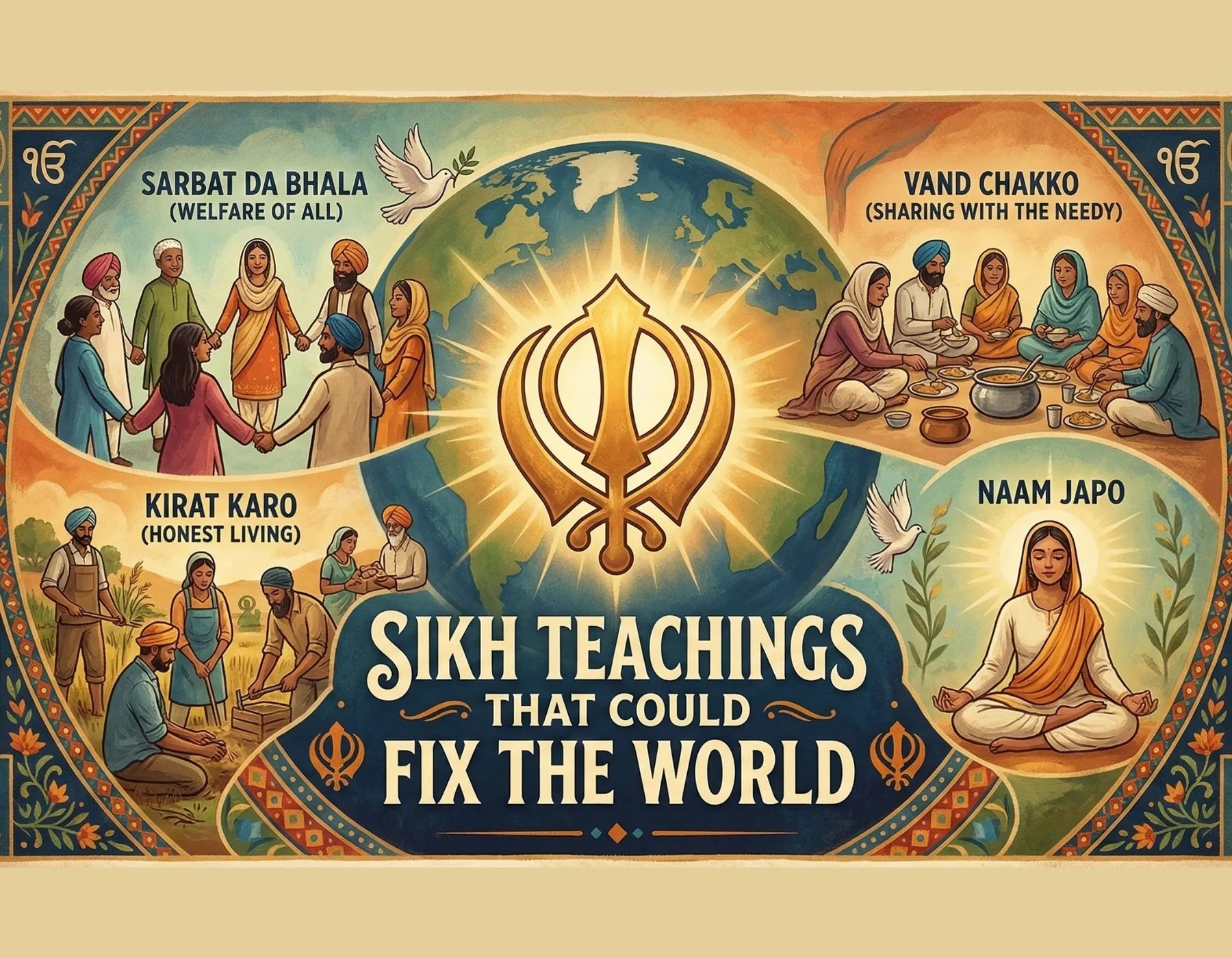
If Seva had a physical symbol, it would be Langar—the free community kitchen found in every Gurdwara (Sikh place of worship). Established by Guru Nanak and formalized by later Gurus, Langar serves free meals to anyone, regardless of religion, race, gender, or social status. No questions asked. No conditions attached.
Think about how radical that was—and still is. In a world structured around economic tiers, Langar erases hierarchy the moment you sit down. Everyone sits on the floor at the same level. A CEO and a laborer eat side by side. A tourist and a refugee share the same meal. It’s equality in action, not theory.
The Golden Temple in Amritsar serves an estimated 50,000 to 100,000 meals daily, and that number can double during major events. All funded and operated largely through volunteer effort. No corporate sponsorship banners. No VIP lines. Just service.
Now ask yourself: what if cities worldwide adopted a similar model? What if food insecurity was addressed not just by government programs but by community-driven kitchens rooted in dignity? According to the United Nations, nearly 735 million people globally face chronic hunger. Langar demonstrates that large-scale, sustainable food distribution is possible when collective responsibility replaces apathy.
But Langar isn’t just about feeding stomachs. It feeds humility. Volunteers wash dishes, chop vegetables, and clean floors together. Titles disappear. Social divisions blur. It’s a weekly reset button reminding participants that service is the highest status.
In a society obsessed with exclusivity, Langar embodies radical inclusion. And that’s precisely why it could help heal a divided world.
Service in the Modern World
Seva doesn’t belong only inside a Gurdwara kitchen. It belongs in boardrooms, classrooms, hospitals, and political offices. The principle can—and should—adapt to modern challenges. You don’t have to wear a turban or identify as Sikh to practice Seva. You just have to shift your focus from “What do I gain?” to “How can I give?”
Consider corporate culture. What if leadership prioritized employee well-being over short-term profit margins? What if CEOs measured success by community impact as much as shareholder returns? Companies that integrate social responsibility often see stronger employee engagement and brand loyalty. Seva, in a business context, could transform exploitative practices into ethical ecosystems.
In healthcare, Seva means treating patients as humans first, cases second. In education, it means teaching students not just to compete but to contribute. In politics, it means legislating for the vulnerable rather than catering exclusively to powerful donors.
Digital spaces need Seva too. Online discourse is often toxic, driven by outrage and ego. Practicing service-minded communication—responding thoughtfully instead of reactively—could lower the temperature of global conversations.
The beauty of Seva is its scalability. It can be as small as helping a neighbor carry groceries or as large as organizing international disaster relief. What matters is the intention. When service becomes habitual rather than occasional, societal transformation follows naturally.
Honest Living in a Corrupt Age
Corruption isn’t always dramatic. It’s not just bribery or embezzlement. It can be subtle—cutting corners, manipulating data, exploiting loopholes, underpaying workers. These behaviors accumulate, slowly eroding trust in institutions. Sikhism addresses this issue head-on with the principle of Kirat Karo, which means “earn honestly.”
At first glance, it sounds simple. Of course we should earn honestly, right? But in a hyper-competitive global economy, shortcuts are tempting. When success stories glorify rapid wealth accumulation without questioning methods, integrity can feel optional. Sikh teachings insist it’s non-negotiable.
Kirat Karo doesn’t just prohibit theft. It calls for ethical labor. It encourages fair trade, transparency, and dignity in work. Whether you’re a farmer, engineer, artist, or entrepreneur, your livelihood should not harm others. Profit gained through exploitation carries spiritual consequences.
Transparency International consistently reports that corruption costs the global economy trillions of dollars annually. Beyond financial loss, corruption destroys public trust. When citizens lose faith in systems, instability grows. Honest earning isn’t just a moral virtue—it’s a stabilizing force.
There’s also psychological freedom in honest living. When your income aligns with your values, you sleep better. You don’t fear exposure. You don’t build success on shaky ground. Sikh teachings frame work as sacred when done ethically. Your office, field, or workshop becomes a place of worship through integrity.
Imagine if political campaigns were fully transparent. Imagine if corporations refused exploitative supply chains. Imagine if financial institutions prioritized ethics over loopholes. Kirat Karo isn’t naïve idealism—it’s practical wisdom designed to sustain long-term prosperity.
Kirat Karo: Earn with Integrity
Earning with integrity goes beyond avoiding crime. It means refusing to benefit from injustice. If a system exploits workers overseas, benefiting from it without question contradicts this principle. Sikh teachings encourage awareness and accountability.
Integrity also demands resilience. Sometimes ethical paths are slower. You might lose deals. You might face criticism for refusing shady practices. But long-term credibility outweighs short-term gain. Businesses built on trust tend to outlast those built on deception.
There’s a powerful psychological component here. When children observe adults cutting corners, they internalize that behavior. But when they see parents and leaders choosing honesty even when it’s difficult, that example shapes future generations. Cultural change begins with consistent personal action.
Integrity in media is equally vital. Misinformation spreads rapidly, influencing elections and social harmony. Practicing Kirat Karo in journalism would mean prioritizing truth over clicks, facts over sensationalism.
This principle challenges each of us. Are we transparent in our taxes? Fair in our wages? Honest in our marketing? The answers shape not only our character but society’s trajectory.
Economic Justice and Fair Systems
Honest earning naturally connects to economic justice. Sikh teachings don’t promote extreme asceticism or reckless wealth accumulation. They advocate balance. Wealth itself isn’t condemned, but hoarding while others suffer contradicts spiritual responsibility.
Economic inequality fuels social unrest. When basic needs like housing, healthcare, and education become inaccessible to large populations, frustration builds. Sikh philosophy counters this by emphasizing fairness and redistribution through voluntary generosity.
Historically, Sikh communities established systems where resources were pooled to support the vulnerable. This wasn’t enforced socialism; it was spiritually motivated sharing. The idea was simple: if you have more than you need, someone else likely has less than they require.
Modern economies could adopt similar values without dismantling markets entirely. Ethical taxation, living wages, and corporate responsibility initiatives align closely with Sikh principles. When systems prioritize human dignity over unchecked accumulation, stability increases.
Economic justice isn’t about punishing success. It’s about ensuring success doesn’t come at the cost of another’s survival. That mindset could reduce crime, improve public health, and strengthen communities.
Sharing and Generosity as Social Glue
If honest earning is one pillar, sharing is the next. Sikhism teaches Vand Chhako, meaning “share what you have.” It completes the ethical cycle: remember the Divine, earn honestly, and share with others.
This principle acknowledges a simple truth—resources are unevenly distributed. Sharing corrects imbalance without resentment. It transforms wealth from a private trophy into a communal tool.
Generosity builds trust. When communities know support is available during hardship, anxiety decreases. Social cohesion strengthens. Studies in behavioral economics show that societies with higher levels of trust experience stronger economic growth and lower crime rates.
Sharing isn’t limited to money. It includes time, knowledge, mentorship, and emotional support. A culture that encourages sharing reduces isolation. Instead of competing constantly, people collaborate.
Vand Chhako: Share What You Have
Vand Chhako makes generosity habitual rather than occasional. It’s not about waiting until you’re extremely wealthy to give back. It’s about integrating sharing into daily life. Even small contributions, when multiplied across communities, create massive impact.
Consider how crowdfunding platforms have funded medical treatments, education, and disaster relief. Now imagine if that spirit wasn’t reactive but proactive—embedded into cultural norms. Sikh teachings encourage exactly that.
Sharing also dismantles greed. The more you give, the less power material possessions hold over you. Freedom grows where attachment shrinks.
If global leaders embraced Vand Chhako, foreign aid policies might prioritize genuine empowerment rather than political leverage. If individuals practiced it consistently, local poverty rates could drop significantly.
Courage and Standing Against Injustice
Compassion without courage is fragile. Sikhism balances service with strength through the concept of the Saint-Soldier. This ideal encourages spiritual depth combined with readiness to defend the oppressed.
History shows Sikhs standing against tyranny despite overwhelming odds. But this wasn’t aggression—it was protection. Violence was a last resort, not a first reaction.
Today, injustice appears in many forms: human trafficking, racial discrimination, authoritarian regimes, domestic abuse. Confronting these issues requires bravery. Silence enables oppression.
The Saint-Soldier mindset teaches that meditation and activism aren’t opposites. You cultivate inner peace so you can act with clarity, not rage. That balance prevents both passivity and extremism.
The Saint-Soldier Ideal
The Saint-Soldier represents harmony between compassion and strength. You pray, but you also protect. You forgive, but you don’t enable harm.
In modern terms, this could look like peaceful protest against unjust laws. It could mean whistleblowing despite personal risk. It could mean defending someone being harassed in public.
Courage is contagious. When one person stands up, others find strength. Sikh teachings cultivate that ripple effect.
Humility and the Battle Against Ego
If ego fuels conflict, humility dissolves it. Sikhism identifies Haumai—the illusion of separateness—as a root cause of suffering. Ego says, “I am superior.” Humility says, “We are connected.”
Leaders consumed by ego make reckless decisions. Relationships crumble when pride overrides empathy. Social media amplifies self-importance. Humility counters all of it.
True humility isn’t weakness. It’s clarity. It recognizes strengths without exaggeration and faults without denial. It creates space for dialogue.
Conquering Haumai (Ego)
Conquering ego requires daily discipline—reflection, gratitude, service. The more you focus on collective well-being, the less obsessed you become with personal image.
Imagine diplomatic negotiations guided by humility rather than dominance. Imagine workplaces where leaders admit mistakes openly. Trust would skyrocket.
Ego divides. Humility unites. It’s that simple—and that difficult.
Conclusion: A Blueprint for a Better World
The world doesn’t lack intelligence. It lacks alignment with timeless values. Sikh teachings offer a cohesive framework: recognize oneness, serve selflessly, earn honestly, share generously, stand courageously, and live humbly.
These aren’t abstract ideals. They’re practical habits. When practiced collectively, they reshape systems from the inside out. Governments become fairer. Economies become more ethical. Communities become stronger.
You don’t have to change your identity to apply these principles. You just have to embody them. Real transformation begins at the individual level but never stays there. It ripples outward.
If even a fraction of humanity adopted these teachings sincerely, the phrase “fix the world” wouldn’t sound so unrealistic.
FAQs
1. Do you have to be Sikh to follow these teachings?
No. These principles are universal human values that anyone can apply regardless of faith.
2. What is the most important Sikh teaching for modern society?
Many would argue it’s the belief in the oneness and equality of all humanity.
3. How does Langar promote equality?
By providing free meals where everyone sits together regardless of status, reinforcing dignity and unity.
4. What does Kirat Karo mean in daily life?
It means earning a living honestly without exploiting others.
5. How can individuals practice Seva today?
By volunteering, helping neighbors, donating resources, or simply acting with consistent compassion.