The Meaning Behind Punjab's Most Popular City Names
Why City Names Matter in Punjab’s Cultural Identity
City names are far more than simple labels on maps. In Punjab, they act like living stories—tiny capsules of history that preserve centuries of culture, religion, migration, and political change. When you hear the name Lahore, Amritsar, Ludhiana, or Multan, you’re not just hearing a geographic marker; you’re hearing echoes of empires, saints, warriors, and myths that shaped the region.
Punjab itself means “The Land of Five Rivers,” derived from the Persian words panj (five) and ab (water). Just as the rivers carved the physical landscape of the region, historical events carved its linguistic and cultural identity. Over thousands of years, Punjab has been influenced by Indus Valley civilizations, Vedic cultures, Persian rulers, Greek invaders, Mughal emperors, Sikh kingdoms, and British colonial administrators. Each era left its fingerprints on the names of cities.
Think of these names as layers in an archaeological site. The deeper you dig, the older the meaning becomes. A single city name might combine Sanskrit mythology, Persian linguistic influence, and colonial modifications. This mixture reflects Punjab’s role as a crossroads of South Asia, where traders, conquerors, and pilgrims constantly passed through.
Names also shape how people emotionally connect to places. For Punjabis, cities are deeply tied to identity, pride, and memory. Lahore, for instance, is often described with the famous phrase “Jinne Lahore nai vekhya, o jamya hi nai”—meaning “Whoever hasn’t seen Lahore hasn’t truly been born.” The name itself carries emotional weight far beyond geography.
Urban historians often argue that place names function like cultural DNA. They reveal what a society valued—religion, rulers, mythology, geography, or heroes. In Punjab, this becomes especially fascinating because the region was repeatedly reshaped by political shifts and the dramatic partition of 1947. Yet the names endured, preserving fragments of a shared history across modern borders.
Understanding the meaning behind Punjab’s most popular city names therefore isn’t just about language. It’s about uncovering stories of faith, power, folklore, and identity that continue to define the Punjabi spirit today.
Historical Layers That Shaped Punjab’s Place Names
Punjab’s city names did not appear overnight. Instead, they evolved gradually through centuries of linguistic blending and historical upheaval. Each era—ancient, medieval, and modern—left distinctive influences on how cities were named or renamed.
In ancient times, many settlements were named using Sanskrit or Prakrit languages, often inspired by geography, mythology, or natural features. Rivers, forests, and hills frequently influenced these names. For example, cities near sacred water bodies often received spiritual titles referencing purity, divinity, or abundance. Religious symbolism played a huge role because early civilizations believed geography itself carried spiritual meaning.
As new empires arrived, the linguistic landscape shifted dramatically. Persian and Central Asian influences entered the region after the Ghaznavid and Mughal expansions, bringing with them Persian administrative language. Many city names either evolved into Persianized versions or gained additional titles. Words like “abad,” “garh,” “pur,” and “nagar” became common suffixes in place names, each indicating a type of settlement or fortified town.
For instance:
| Suffix | Meaning | Example |
|---|---|---|
| -abad | Settlement or prosperous city | Faisalabad |
| -garh | Fort or fortified place | Batala Garh (historic reference) |
| -pur | Town or city | Jodhpur (similar usage across India) |
| -nagar | Urban settlement | Srinagar |
During the Sikh Empire in the 18th and early 19th centuries, new towns emerged or older ones gained significance due to strategic, economic, or religious importance. Sikh rulers often named places after leaders, saints, or family members, adding another cultural layer.
Then came the British colonial period, which introduced entirely different naming patterns. Colonial administrators frequently named cities after British officers, governors, or royalty. However, after independence in India and Pakistan, many of these colonial names were changed to reflect local heritage or national identity.
A classic example is Lyallpur, named after British officer Sir James Lyall. After Pakistan’s independence, it was renamed Faisalabad to honor King Faisal of Saudi Arabia.
This constant renaming reveals something fascinating: city names are political as much as they are cultural. Every new authority tried to imprint its identity on the landscape. Yet despite these changes, older meanings often survived in everyday speech, folklore, and literature.
Punjab’s place names therefore act like historical fingerprints, showing how language, religion, and power interacted across millennia. When you analyze these names closely, they become windows into the region’s complex and fascinating past.
Lahore – The Legendary Heart of Punjab
Among all Punjabi cities, Lahore holds a special place in history, culture, and imagination. Often called the “Cultural Capital of Punjab,” Lahore has existed for so long that historians struggle to pinpoint its exact founding date. Some estimates suggest the city may be over 2,000 years old, though legends claim it is even older.
Lahore’s importance grew significantly during the Mughal Empire, when emperors like Akbar, Jahangir, and Shah Jahan transformed it into one of South Asia’s most magnificent cities. Monumental architecture such as the Lahore Fort, Badshahi Mosque, and Shalimar Gardens still reflects that golden era. Yet the significance of Lahore isn’t only about its buildings—it’s about what the city represents for Punjabi identity.
For centuries, Lahore functioned as a gateway between Central Asia and the Indian subcontinent. Traders, scholars, poets, and soldiers all passed through its gates. Because of this constant movement, Lahore developed a rich multicultural atmosphere where Persian poetry, Punjabi folklore, and Mughal art blended seamlessly.
The city also played a central role in political and intellectual movements. It was in Lahore that the historic Pakistan Resolution was passed in 1940, laying the foundation for the creation of Pakistan. On the Indian side of Punjab, Lahore remains deeply connected to shared cultural memory before the partition.
But Lahore’s legacy goes beyond politics and empire. The city is also known for its food, literature, music, and festivals. From sizzling street food in the old walled city to literary gatherings celebrating poets like Allama Iqbal and Faiz Ahmed Faiz, Lahore constantly reinforces its reputation as the beating heart of Punjabi culture.
Even linguistically, the name “Lahore” carries deep historical resonance. Scholars debate its origin, linking it to ancient mythology, early settlements, and linguistic evolution across centuries. The meaning of Lahore’s name has inspired historians, poets, and storytellers alike.
Understanding the story behind the name Lahore helps explain why this city holds such a powerful emotional place in Punjabi consciousness. It is not merely a metropolis—it is a symbol of heritage, resilience, and cultural pride.
The Etymology of Lahore’s Name
The origin of the name Lahore is wrapped in legend, mythology, and linguistic evolution. One of the most popular theories connects the city to Lav (or Loh), the son of the Hindu god-king Rama from the epic Ramayana. According to this tradition, Lav founded the city, which was originally called Lavapuri or Lohawar—meaning “the city of Lav.”
Over time, linguistic changes gradually transformed these early names. Languages evolve like living organisms, and pronunciation shifts naturally across generations. Scholars believe Lavapuri → Lohawar → Lahawar → Lahore represents the gradual phonetic evolution of the city’s name across centuries.
Historical references support the idea that the name existed long before the Mughal period. The famous Chinese traveler Xuanzang, who visited the region in the 7th century, recorded settlements that many historians associate with early Lahore. Persian chronicles later mentioned the city using variations like Lahawar.
Another interpretation connects the name to the fortified structure that once stood at the city’s center. Some linguists suggest the word may derive from terms related to iron or fortification, symbolizing a strong defensive settlement. This theory aligns with the region’s history of fortified cities designed to protect trade routes.
The Mughal era solidified the spelling and pronunciation closer to what we recognize today. Persian administrative records consistently referred to the city as Lahore, which gradually became the standard form used in maps, literature, and official documents.
What makes Lahore’s name particularly fascinating is how it bridges mythology and documented history. On one hand, the story of Lav links the city to ancient epic traditions. On the other, historical records show the city evolving through real political and linguistic transformations.
Today, the name Lahore symbolizes far more than its possible mythological founder. It represents centuries of artistic expression, intellectual debate, and cultural pride. The city’s name has become shorthand for Punjabi identity itself, embodying a legacy that continues to influence South Asian culture, literature, and politics.
Lahore as a Symbol of Punjabi Heritage
Lahore is often described as the soul of Punjab, and the city’s name carries an emotional and cultural weight that extends far beyond its geographic boundaries. Over centuries, Lahore evolved from a legendary settlement into a vibrant cultural hub where poetry, cuisine, architecture, and intellectual life flourished side by side. When people discuss Punjabi identity, Lahore almost always sits at the center of that conversation.
Historically, Lahore’s symbolic status began during the Mughal Empire, when the city served as a major imperial capital. Emperor Akbar made Lahore the seat of his empire for several years in the late 16th century, transforming it into a political and artistic powerhouse. During this period, magnificent structures like the Lahore Fort and the Shalimar Gardens were constructed, both of which still stand as UNESCO World Heritage Sites today. These monuments didn’t just beautify the city—they helped cement Lahore’s reputation as a place where art, architecture, and cultural expression thrived.
The city also became a cradle of literary and intellectual movements. Lahore produced or hosted some of the greatest thinkers and poets of South Asia, including Allama Iqbal, Faiz Ahmed Faiz, Saadat Hasan Manto, and Bulleh Shah. Their works often referenced the spirit of Lahore, portraying it as a city of ideas, rebellion, and creativity. Because of this literary legacy, the name Lahore became synonymous with intellectual freedom and artistic vitality.
Another factor that elevated Lahore’s cultural symbolism is its famous old walled city. Inside its gates lie centuries-old bazaars, mosques, and havelis that preserve the atmosphere of historic Punjab. Walking through streets like Anarkali Bazaar or Food Street near Badshahi Mosque feels like stepping into a living museum. The traditions, food aromas, and architecture all reinforce the city’s deep-rooted identity.
Even today, the phrase “Lahore Lahore Hai” (Lahore is simply Lahore) reflects the belief that the city is incomparable. It captures a sense of pride that locals feel about their heritage. Lahore’s name has become shorthand for culture, celebration, and resilience, representing the enduring spirit of Punjab despite centuries of political and social change.
Amritsar – The City of Sacred Nectar
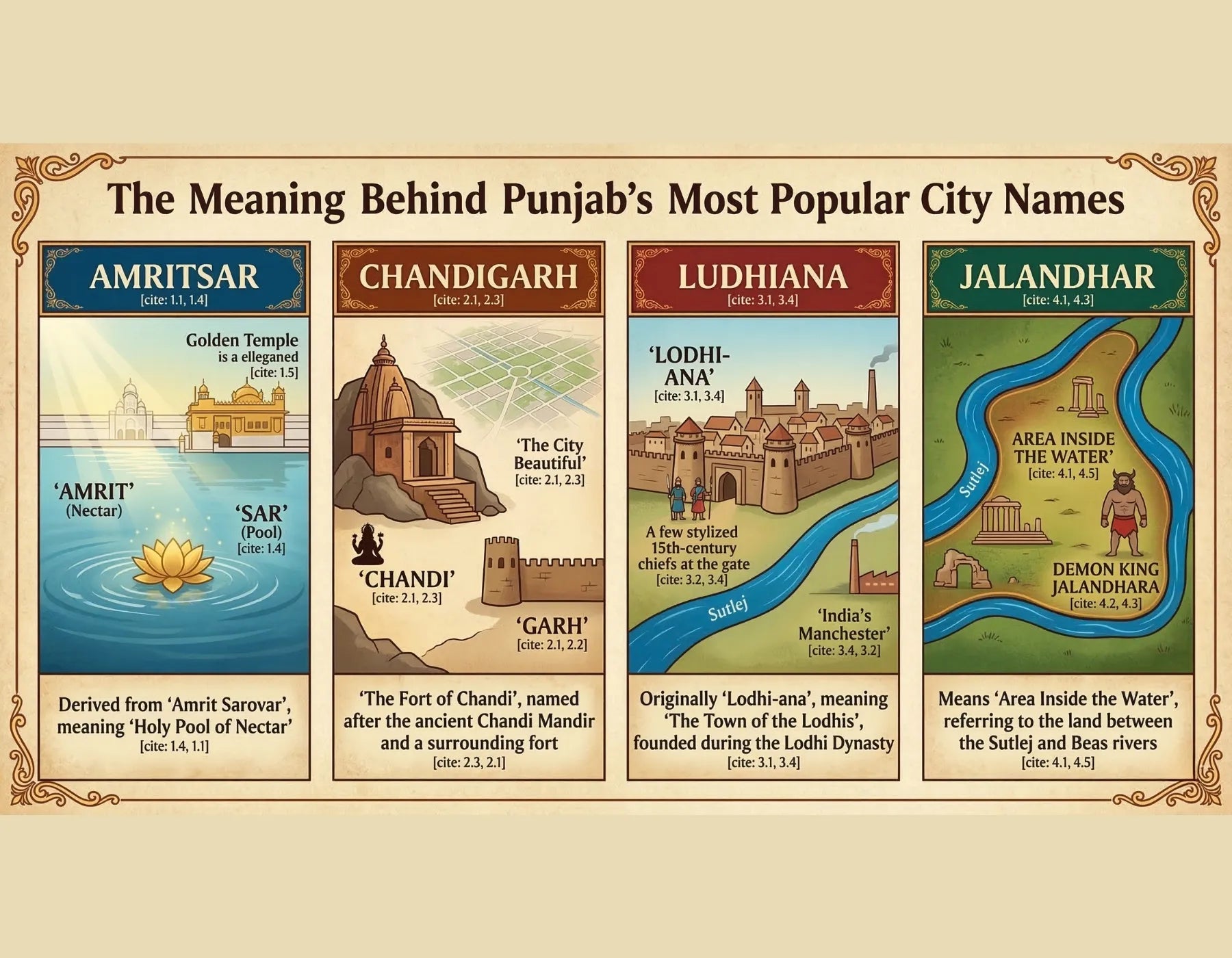
The city of Amritsar, located in the Indian state of Punjab, holds immense spiritual significance for millions of people around the world. Its name itself carries deep religious meaning, reflecting the city’s close connection to Sikh faith and sacred traditions. When translated literally, “Amritsar” means “Pool of Nectar” or “Lake of Immortality.”
The story of Amritsar begins in the late 16th century during the time of Guru Ram Das, the fourth Sikh Guru. In 1577, Guru Ram Das founded the settlement around a sacred water tank that was believed to possess spiritual purity and healing power. The tank was later completed and expanded by Guru Arjan Dev, the fifth Sikh Guru, who also oversaw the construction of the Harmandir Sahib, famously known as the Golden Temple.
The sacred pool, called Amrit Sarovar, quickly became the spiritual center of the Sikh community. Pilgrims began traveling from distant regions to bathe in the waters, believing they would receive blessings and spiritual renewal. As the settlement grew around this sacred site, the name Amritsar naturally emerged from the words Amrit (nectar of immortality) and Sar (pool or lake).
Over time, the city developed into much more than a religious pilgrimage destination. Amritsar became a bustling center of trade, craftsmanship, and cultural exchange. Its markets, such as the famous Hall Bazaar, attracted merchants dealing in textiles, spices, and traditional Punjabi handicrafts. Even today, Amritsar remains known for its vibrant bazaars and rich culinary traditions, including dishes like Amritsari kulcha and lassi.
Amritsar also occupies an important place in modern history. The tragic Jallianwala Bagh massacre of 1919, where British troops fired on peaceful protesters, became a turning point in India’s struggle for independence. This event forever etched the city’s name into the historical memory of the subcontinent.
Because of its spiritual, cultural, and historical importance, the name Amritsar resonates deeply with Sikh communities worldwide. It represents faith, resilience, and unity, reminding visitors and residents alike of the city’s sacred origins and enduring legacy.
The Origin of the Name Amritsar
The name Amritsar originates directly from the sacred water reservoir known as the Amrit Sarovar, which surrounds the Golden Temple. In the Punjabi and Sanskrit linguistic tradition, the word “Amrit” refers to the mythical nectar of immortality mentioned in ancient Indian scriptures. According to Hindu and Sikh mythology, amrit is a divine substance capable of granting eternal life and spiritual purity.
The second part of the name, “Sar” or “Sarovar,” means a pool, lake, or large body of water. When combined, the phrase essentially means “The Pool of Divine Nectar.” This powerful imagery perfectly captures the spiritual significance of the location where the city was founded.
Guru Ram Das initially named the settlement Ramdaspur, after himself. However, as the sacred pool gained religious prominence and the Golden Temple became the focal point of Sikh worship, the city gradually came to be known as Amritsar, referencing the holy water body at its center.
Pilgrims believe that bathing in the Amrit Sarovar symbolizes spiritual cleansing and renewal. While the ritual is primarily symbolic rather than literal purification, the idea of sacred water holds immense importance in Sikh tradition. The concept reflects the belief that faith and humility can cleanse the soul just as water cleanses the body.
The name Amritsar also reflects the broader philosophy of Sikhism, which emphasizes equality, service, and devotion to humanity. The Golden Temple’s famous Langar (community kitchen) serves free meals to tens of thousands of people every day, regardless of religion, caste, or social status. This tradition embodies the spiritual message associated with the “nectar of immortality”—a metaphor for compassion and unity.
Today, Amritsar stands not only as a geographical city but also as a symbol of spiritual nourishment. The name reminds visitors that the city was built around an idea: the belief that faith, humility, and community can create a place of peace and belonging.
Chandigarh – The Modern City of the Goddess
Unlike many ancient cities of Punjab, Chandigarh represents a completely different chapter in the region’s history. While cities like Lahore and Amritsar grew organically over centuries, Chandigarh was carefully planned and designed in the mid-20th century. Yet despite its modern origin, the city’s name is deeply rooted in ancient mythology.
Chandigarh was created after the Partition of India in 1947, which divided Punjab between India and Pakistan. The historic city of Lahore, which had served as the capital of undivided Punjab, became part of Pakistan. As a result, the Indian state of Punjab needed a new capital. The Indian government decided to build a modern city from scratch, symbolizing progress and a fresh beginning.
The task of designing Chandigarh was given to the renowned Swiss-French architect Le Corbusier, one of the pioneers of modern urban planning. His vision transformed Chandigarh into one of the most organized and architecturally significant cities in Asia. Wide roads, green spaces, and carefully designed sectors created a city that looked dramatically different from traditional South Asian urban layouts.
Despite its modern architecture, the name Chandigarh connects the city to much older religious traditions. The name is derived from Chandi, a fierce form of the Hindu goddess Durga, and Garh, meaning fort or stronghold. Essentially, Chandigarh means “The Fort of Goddess Chandi.”
The name comes from the nearby Chandi Mandir temple, which existed long before the city itself was constructed. The temple, located in the Shivalik foothills, was dedicated to the goddess Chandi and served as an important religious site for local communities. When planners were choosing a name for the new capital, they decided to honor this historic spiritual landmark.
Today, Chandigarh stands as one of the most unique cities in India. It serves as the capital of both Punjab and Haryana, while also functioning as a union territory administered by the central government. The city’s clean design, extensive parks, and cultural institutions make it one of the most livable cities in South Asia.
The name Chandigarh beautifully illustrates how modern progress and ancient heritage can coexist. Even though the city was built in the 20th century, its name preserves a connection to centuries-old mythology and religious devotion.
Meaning and Mythology Behind Chandigarh
The mythology behind the name Chandigarh adds a fascinating spiritual dimension to what is otherwise a modern urban landscape. The goddess Chandi, from whom the city takes its name, is considered a powerful and protective form of the goddess Durga in Hindu tradition. She symbolizes strength, courage, and the destruction of evil forces.
According to local folklore, the region around present-day Chandigarh was once believed to be protected by the goddess Chandi. The Chandi Mandir temple, situated roughly 15 kilometers from the city, served as a focal point for worship and pilgrimage. Devotees visited the temple seeking blessings for protection, victory, and prosperity.
The word “Garh” in Chandigarh’s name historically refers to a fortified place or stronghold. Many ancient settlements in northern India used this suffix because fortified towns were essential for defense during times of war and invasion. When combined with the goddess’s name, the meaning becomes “Fortress of Goddess Chandi.”
Interestingly, this symbolism fits perfectly with the historical moment when the city was created. After the upheaval of Partition, Punjab needed a new capital that could represent strength, resilience, and renewal. Naming the city after a powerful protective deity carried symbolic significance—it suggested hope and stability in a time of dramatic change.
Chandigarh’s planners also incorporated spiritual symbolism into the city’s architecture and layout. For example, the Open Hand Monument, designed by Le Corbusier, represents peace and reconciliation. The monument symbolizes the idea that the city is “open to give and open to receive.”
Today, Chandigarh is often referred to as “The City Beautiful.” Its clean streets, carefully planned sectors, and abundant greenery create a calm and organized environment rarely seen in other major South Asian cities. Yet beneath its modern appearance lies a name that connects the city to ancient mythology and regional traditions.
The meaning behind Chandigarh’s name shows how even a newly built city can carry the weight of history and spirituality. By honoring the goddess Chandi, the city preserves a link between modern urban life and timeless cultural beliefs.
Ludhiana – A City Rooted in the Lodhi Dynasty
The city of Ludhiana, located in the Indian state of Punjab, stands today as one of the region’s most important industrial and commercial hubs. Known for its thriving textile and manufacturing industries, Ludhiana produces a significant portion of India’s woolen garments, bicycles, and machine tools. Yet behind this modern economic powerhouse lies a fascinating historical origin tied to a medieval ruling dynasty.
Ludhiana’s name is closely linked to the Lodhi dynasty, which ruled parts of northern India during the 15th and early 16th centuries. The Lodhis were an Afghan dynasty that eventually became the last rulers of the Delhi Sultanate before the rise of the Mughal Empire. Their influence extended across large parts of Punjab, and several settlements during this period were established or fortified under their authority.
The origins of Ludhiana date back to around 1480, when two Lodhi chiefs—Yusuf Khan and Nihand Khan—were sent by the Delhi Sultanate to control the region and establish a military outpost. At the time, the area consisted mostly of scattered villages and agricultural land near the Sutlej River. The Lodhi commanders built a fortified settlement to secure trade routes and maintain political control over the surrounding territories.
As the settlement grew, it gradually came to be associated with the Lodhi rulers who had established it. The original name is believed to have been “Lodhi-ana”, which literally meant “the town of the Lodhis.” Over time, through linguistic shifts and pronunciation changes in Punjabi and Hindi, the name evolved into Ludhiana.
What makes Ludhiana particularly interesting is how its name reflects political history rather than mythology or geography. Unlike cities such as Amritsar or Chandigarh, whose names come from religious traditions, Ludhiana’s identity is rooted in the legacy of a ruling dynasty.
During the British colonial period, Ludhiana gained additional importance as a military cantonment and trade center. The British established educational institutions, administrative offices, and railway connections, which accelerated the city’s development. By the early 20th century, Ludhiana had already begun transforming into a manufacturing center.
Today, Ludhiana is often called the “Manchester of India” because of its massive textile industry. Despite this modern reputation, the city’s name continues to preserve a reminder of its origins in the Lodhi dynasty—a time when Punjab’s cities were shaped by powerful rulers and strategic military settlements.
How the Lodhi Rulers Inspired the Name
To fully understand the meaning behind the name Ludhiana, it is essential to explore the historical influence of the Lodhi dynasty, which ruled northern India between 1451 and 1526. The dynasty was founded by Bahlul Lodhi, an Afghan noble who became the Sultan of Delhi and established control over a vast territory stretching across parts of modern-day India and Pakistan.
The Lodhi rulers were known for strengthening administrative systems and building military outposts across strategic regions. Punjab, because of its location as a gateway between Central Asia and the Indian plains, was particularly important. The Lodhis recognized the need to secure this region both politically and economically.
When Lodhi commanders established a settlement in the area that would become Ludhiana, the place naturally became associated with their rule. The original term “Lodhi-ana” combines the dynasty’s name with the suffix “-ana,” which in Persian-influenced languages often indicates a place connected with a person or group. In simple terms, Lodhi-ana meant “the place of the Lodhis.”
As the centuries passed, language evolved through everyday speech. Punjabi pronunciation gradually softened the word, transforming Lodhi-ana into Ludhiana. This linguistic evolution is common in South Asian place names, where pronunciation changes occur due to regional dialects and cultural influences.
Interestingly, even though the Mughal Empire replaced the Lodhi dynasty after the First Battle of Panipat in 1526, the name Ludhiana remained unchanged. This shows how place names often outlive the political powers that created them. Once a name becomes embedded in local identity and daily language, it tends to survive long after the original rulers disappear.
Today, Ludhiana’s name serves as a historical reminder of a transitional period in Indian history—the moment when Afghan rulers of the Delhi Sultanate were shaping the political landscape just before the arrival of the Mughal Empire. The city’s name therefore acts like a linguistic monument, preserving the memory of a dynasty that once controlled northern India.
Jalandhar – The City of Ancient Legends
Among Punjab’s oldest cities, Jalandhar stands out for its deep roots in ancient mythology and early Indian civilization. Unlike some cities whose names emerged during medieval or colonial times, Jalandhar’s origins stretch back thousands of years, making it one of the most historically rich places in the region.
The city is mentioned in several ancient Indian texts, including the Mahabharata and various Puranas, which indicates that the settlement existed in some form long before the medieval era. Because of these early references, historians often regard Jalandhar as one of the oldest continuously inhabited cities in Punjab.
One popular interpretation of the name Jalandhar connects it to the Sanskrit words “Jal” (water) and “Andhar” or “Dhara” (holding or containing). According to this theory, the name describes a land surrounded or held by water, which fits geographically since the region historically lay between rivers of the Punjab plains.
However, another widely accepted explanation comes from Hindu mythology, which tells the story of a powerful demon king named Jalandhara. According to legend, this demon was born from the fiery energy of Lord Shiva and became nearly invincible due to divine blessings. His kingdom was believed to be located in the region that later became the city of Jalandhar.
In the myth, Jalandhara eventually became so powerful that he challenged the gods themselves. After a long cosmic battle, he was finally defeated by Lord Shiva. The region where he ruled was thereafter associated with his name, eventually becoming known as Jalandhar.
Historically, the city later became an important center during the Maurya, Gupta, and Mughal periods, as well as under Sikh rule. Because of its location on major trade routes, Jalandhar developed into a hub for commerce, culture, and education.
Today, Jalandhar is known for its sports goods manufacturing industry, producing equipment exported worldwide. Despite this modern identity, the city’s ancient name continues to evoke images of mythological battles, sacred legends, and early Indian civilization.
Mythological Roots of Jalandhar
The mythological origins of Jalandhar provide one of the most fascinating stories behind any Punjabi city name. According to Hindu mythology, the demon king Jalandhara was not an ordinary villain but a powerful being born under extraordinary circumstances.
Legend says that Jalandhara emerged from the third eye of Lord Shiva when a spark of divine energy fell into the ocean. The sea god Varuna raised the child, and because he came from water, he was named Jalandhara, which literally translates to “one who holds water” or “born of water.”
As he grew older, Jalandhara became a mighty ruler with immense strength and magical abilities. His power was so great that he challenged the gods and even threatened their celestial kingdoms. The gods struggled to defeat him because he possessed divine protection granted by his virtuous wife, Vrinda, whose unwavering devotion made him nearly invincible.
Eventually, through divine intervention and strategic deception, the gods were able to break the protective power surrounding Jalandhara. In the final battle, Lord Shiva defeated the demon king, restoring balance to the universe. After his death, the region associated with his kingdom was believed to carry his name.
While historians recognize that mythology and geography often blend together in ancient place names, the story of Jalandhara reflects how legends helped communities explain the origins of important locations. Even if the myth cannot be verified historically, it remains deeply embedded in cultural memory.
Today, the name Jalandhar symbolizes not just a city but also a rich tapestry of myth, religion, and storytelling that has been passed down through generations. It reminds us that many place names in South Asia carry narratives that stretch far beyond written history, connecting modern cities with ancient legends.
Patiala – The Royal Legacy of Ala Singh
The city of Patiala, located in the southeastern part of Indian Punjab, owes its name and historical identity to the royal family that once ruled the region. Unlike cities rooted in mythology or ancient civilizations, Patiala’s story begins in the 18th century during the rise of Sikh power in Punjab.
Patiala was founded in 1763 by Baba Ala Singh, a prominent Sikh leader and the founder of the Patiala State, which later became one of the most influential princely states during the British Raj. Ala Singh belonged to the Phulkian dynasty, a powerful Sikh lineage that controlled several territories in the region.
The name Patiala is believed to have evolved from the phrase “Patti Ala”, which roughly translates to “the land or territory of Ala Singh.” Over time, the pronunciation gradually shifted, eventually becoming Patiala.
Under the leadership of Ala Singh and his successors, the city grew into a major political and cultural center. The rulers of Patiala built impressive palaces, forts, and gardens that reflected a blend of Sikh, Mughal, and Rajput architectural influences. Structures like the Qila Mubarak complex and Sheesh Mahal still stand as reminders of the city’s royal heritage.
During the British colonial period, Patiala State became one of the most powerful princely states allied with the British Empire. The Maharajas of Patiala enjoyed considerable autonomy and wealth, which allowed them to invest heavily in infrastructure, education, and cultural institutions.
Even today, Patiala’s identity is strongly associated with royal traditions, classical music, and distinctive fashion. The famous Patiala salwar, a traditional style of Punjabi trousers with numerous pleats, originated in the royal court and eventually became a popular fashion across South Asia.
The name Patiala therefore represents more than a geographic location—it reflects a legacy of leadership, royal patronage, and cultural influence that shaped the region for centuries.
How Patiala Got Its Name
The naming of Patiala is directly tied to its founder, Baba Ala Singh, whose leadership played a crucial role in establishing Sikh political power in the region during the 18th century. Ala Singh began as a local chieftain but gradually expanded his authority by uniting surrounding territories and strengthening military defenses.
When Ala Singh established his capital in the area, the territory was commonly referred to as “Patti Ala Singh.” In Punjabi, the word “Patti” refers to a tract of land or administrative division. Essentially, the phrase meant “Ala Singh’s territory.”
As the settlement expanded into a full-fledged city, the name evolved linguistically. Spoken language tends to simplify longer phrases, especially over generations. Gradually, Patti Ala transformed into Patiala, a shorter and more convenient form used in everyday conversation.
The city soon became the political heart of the Patiala Kingdom, which later emerged as the largest princely state in Punjab during the British era. The rulers invested heavily in architecture, arts, and education, giving the city a distinctive royal character.
Even today, Patiala’s name evokes images of grand palaces, royal courts, classical music traditions, and vibrant Punjabi culture. The city remains famous for the Patiala gharana, a style of Hindustani classical music that produced legendary singers such as Bade Ghulam Ali Khan.
The evolution of the name Patiala shows how personal legacy can shape geographic identity. What began as a simple reference to a ruler’s territory eventually became the name of one of Punjab’s most culturally significant cities.
Conclusion
The names of Punjab’s cities are far more than labels on a map—they are living pieces of history that capture centuries of cultural, religious, and political change. From the mythological origins of Lahore and Jalandhar to the spiritual symbolism of Amritsar, the dynastic influence behind Ludhiana, and the royal legacy reflected in Patiala, each name tells a unique story about the forces that shaped the region.
These names reveal how Punjab has always been a crossroads of civilizations. Ancient myths, Persian linguistic influences, Sikh traditions, colonial politics, and modern national identities have all played a role in shaping the way cities are named and remembered. Each generation inherited these names while adding its own interpretations and meanings.
Understanding the origins of these cities helps us appreciate how geography, language, and history intertwine to form cultural identity. A simple city name can preserve centuries of legends, dynasties, spiritual beliefs, and historical turning points.
Today, as Punjab continues to grow and modernize, these historic names remain powerful reminders of the region’s rich and diverse heritage. They serve as bridges between the past and the present, ensuring that the stories of Punjab’s people, rulers, saints, and legends are never forgotten.
FAQs
1. Why do many cities in Punjab have historical or mythological names?
Punjab has been inhabited for thousands of years and influenced by multiple civilizations, including Vedic, Persian, Mughal, Sikh, and British cultures. Because of this long history, city names often reflect mythology, rulers, religious beliefs, or geographical features that were important at the time the settlements were established.
2. What does the name Punjab itself mean?
The word Punjab comes from Persian, where “Panj” means five and “Ab” means water. Together, the term means “Land of Five Rivers,” referring to the five major rivers that historically flowed through the region.
3. Which Punjabi city has the oldest historical origin?
Cities like Lahore and Jalandhar are considered among the oldest in the region. Historical references to these places appear in ancient texts and travel accounts dating back many centuries.
4. Why was Chandigarh built as a planned city?
Chandigarh was built after the Partition of India in 1947 because the historic capital of Punjab, Lahore, became part of Pakistan. The Indian government decided to create a new modern capital, which was designed by the famous architect Le Corbusier.
5. Are city names in Punjab ever changed?
Yes, city names have changed throughout history due to political shifts or cultural reasons. For example, Lyallpur was renamed Faisalabad in Pakistan after independence to honor Saudi King Faisal.