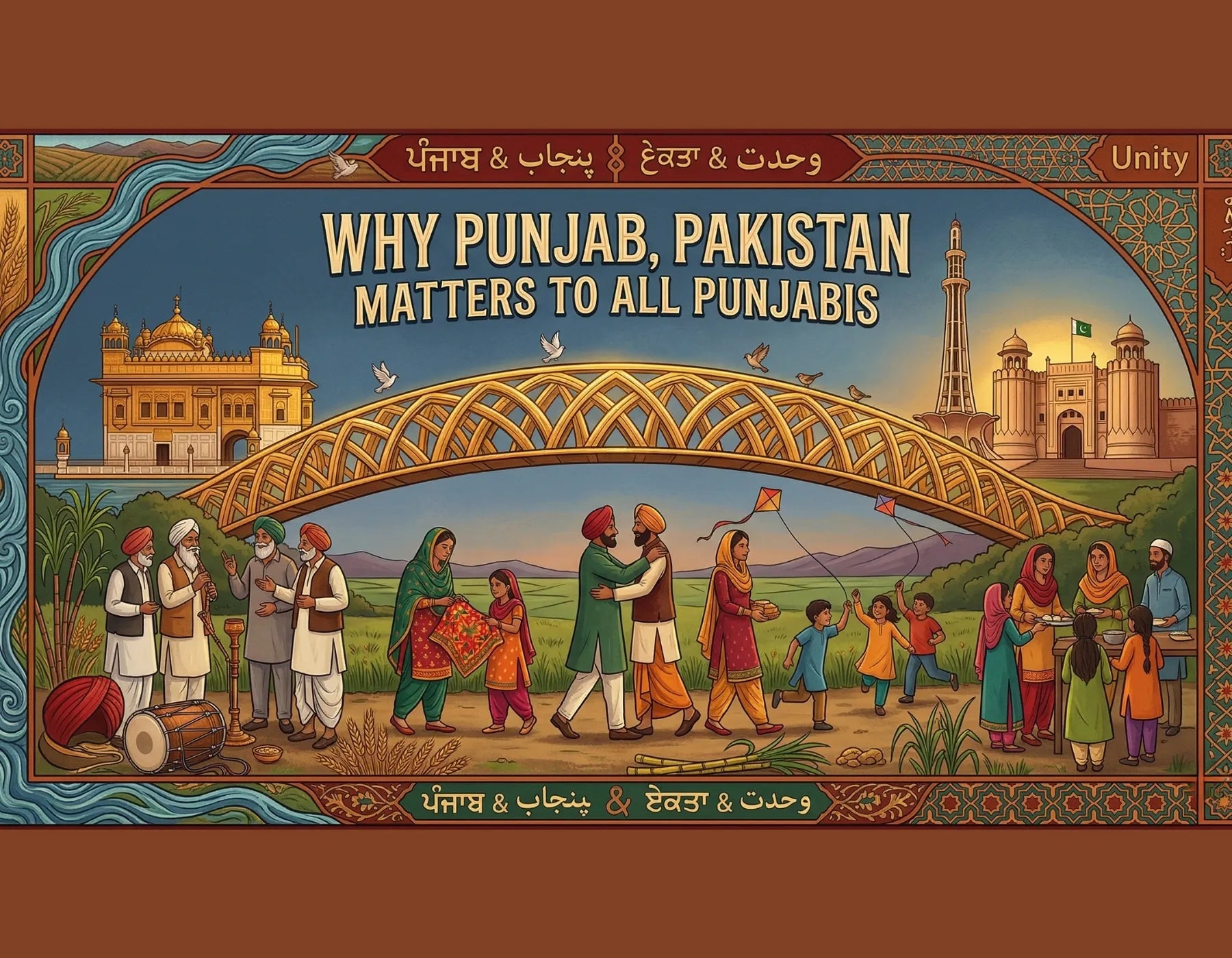
Why Punjab, Pakistan Matters To All Punjabis
Understanding the Shared Identity of Punjabis
The Roots of Punjabi Ethnicity and Culture
If you’ve ever met a Punjabi—whether from Pakistan, India, or the diaspora—you’ve probably noticed something striking: a shared warmth, a loud laugh, and a deep love for culture. That’s not accidental. Punjabi identity runs deeper than borders, politics, or passports. It’s rooted in centuries of shared history, traditions, and collective memory that continue to bind millions of people together.
Punjab, historically known as the “Land of Five Rivers,” has always been a crossroads of civilizations. From the Indus Valley Civilization to the Mughal Empire, this region has seen waves of cultural influences that shaped what we now recognize as Punjabi culture. What makes Punjab, Pakistan particularly significant is that it holds a substantial portion of this historical and cultural legacy. Cities like Lahore, Multan, and Faisalabad are not just urban centers—they are living museums of Punjabi heritage.
Think about it like a family home. Even if siblings move to different countries, that original home still carries emotional weight. Punjab, Pakistan serves as that “home base” for many Punjabis. It’s where traditions were preserved in their most organic form, especially after the Partition of 1947 reshaped the subcontinent. The folk songs, the storytelling traditions, the rural lifestyles—they all continue to thrive here in a way that feels authentic and deeply rooted.
What’s fascinating is how these cultural elements transcend religion. Whether Sikh, Muslim, or Hindu, Punjabis share similar customs in weddings, music, and even humor. This shared cultural DNA makes Punjab, Pakistan more than just a geographical location—it becomes a symbol of collective identity.
Language as the Heartbeat of Punjab
Language is often described as the soul of a culture, and for Punjabis, that soul speaks in Punjabi. No matter where you go—Canada, the UK, India, or Pakistan—you’ll hear the same rhythmic tones, the same expressive phrases, and the same emotional depth embedded in the Punjabi language. But here’s the thing: Punjab, Pakistan plays a crucial role in keeping this language alive.
With over 80 million speakers in Pakistan alone, Punjabi remains one of the most widely spoken languages in the world. Yet, paradoxically, it faces challenges in formal recognition and institutional support. Despite this, it thrives in everyday life—on the streets, in homes, in music, and in storytelling. This organic survival is what makes Punjab, Pakistan so important. It acts as a living, breathing hub where Punjabi isn’t just spoken—it’s lived.
Consider Punjabi poetry and literature. Legendary poets like Bulleh Shah, Waris Shah, and Mian Muhammad Bakhsh all hail from regions that are now part of Pakistan. Their works continue to influence Punjabi thought across borders. When a Punjabi in India recites Heer Ranjha, they are, in essence, connecting with a literary tradition deeply rooted in Pakistani Punjab.
And let’s not forget music. From Sufi qawwalis to modern Punjabi pop, much of the creative energy originates in Punjab, Pakistan. Artists here have managed to preserve the linguistic richness while adapting to contemporary tastes. This balance between tradition and modernity ensures that the Punjabi language remains relevant, not just nostalgic.
In a world where languages are disappearing at an alarming rate, Punjab, Pakistan stands as a stronghold for Punjabi. It keeps the language dynamic, evolving, and accessible. For Punjabis everywhere, that’s not just important—it’s essential for preserving who they are.
Historical Significance of Punjab, Pakistan
Pre-Partition Punjab: A Unified Land
Before 1947, Punjab wasn’t divided by barbed wires or political ideologies. It was a unified region where communities coexisted, traded, celebrated, and lived together. Muslims, Sikhs, and Hindus shared not just land but also culture, language, and traditions. Cities like Lahore were melting pots of diversity, bustling with intellectual activity, commerce, and artistic expression.
Punjab, Pakistan today holds many of the historical sites that tell the story of this unified past. From ancient forts to colonial architecture, these landmarks serve as reminders of a time when Punjabi identity was not fragmented. Walking through the streets of Lahore’s Old City is like flipping through the pages of history—you see influences from different eras coexisting in harmony.
This historical continuity makes Punjab, Pakistan incredibly significant. It preserves the physical and cultural remnants of a shared past that many Punjabis, especially those in the diaspora, feel disconnected from. Visiting these places often becomes a deeply emotional experience, almost like reconnecting with lost roots.
The Impact of Partition on Punjabi Identity
Partition was not just a political event; it was a deeply human tragedy that reshaped identities overnight. Millions were displaced, families were torn apart, and a once-unified Punjab was split into two. The scars of this division are still felt today, both physically and emotionally.
Punjab, Pakistan became home to many who migrated from Indian Punjab, bringing with them stories, traditions, and memories. Over time, these elements blended with existing cultural practices, creating a unique yet familiar Punjabi identity. This evolution is what makes Punjab, Pakistan so important—it became a space where fragmented identities could rebuild and redefine themselves.
For many Punjabis around the world, Pakistan’s Punjab represents a piece of history that was lost but never forgotten. It’s a reminder of resilience, adaptation, and the enduring power of culture.
Cultural Richness That Connects All Punjabis
Festivals, Traditions, and Shared Celebrations
Close your eyes and picture a Punjabi celebration—there’s music pulsing in the background, vibrant colors everywhere, people laughing loudly, and food being passed around endlessly. That image doesn’t belong to just one side of the border. It belongs to all Punjabis. And at the heart of preserving these lively traditions is Punjab, Pakistan, where many of these customs continue to exist in their most unfiltered and authentic forms.
Take festivals like Basant, for example. The kite-flying festival, once celebrated widely across Punjab, found its strongest expression in Lahore. Rooftops filled with people, skies painted with kites, and the electrifying chants of “Bo kata!”—it’s more than a festival; it’s an emotional experience tied to Punjabi identity. Even though Basant has faced restrictions over time, its cultural imprint remains deeply embedded in the Punjabi psyche across the globe.
Then there are weddings, which are practically a cultural spectacle. The dhol beats, bhangra performances, mehndi ceremonies, and elaborate family gatherings are strikingly similar whether you’re in Amritsar or Faisalabad. Much of this shared tradition has been preserved and continuously practiced in Punjab, Pakistan, where rural and urban communities alike hold tightly to these customs. It acts almost like a cultural time capsule, allowing other Punjabis to reconnect with traditions that may have evolved or faded elsewhere.
What makes these celebrations so powerful is their ability to transcend religious and political boundaries. A Punjabi Muslim wedding in Lahore and a Sikh wedding in Indian Punjab might differ in rituals, but the emotional energy, music, and sense of community feel almost identical. That’s the magic of Punjabi culture—it refuses to be confined.
In many ways, Punjab, Pakistan functions like a cultural anchor. It keeps these traditions alive, not as staged performances but as everyday realities. For Punjabis living abroad, watching a wedding video from Lahore or hearing about a Basant celebration often sparks nostalgia. It reminds them of a cultural rhythm that still beats strongly somewhere in the world.
Food Culture as a Unifying Force
If there’s one thing that instantly connects Punjabis, it’s food. Rich, flavorful, unapologetically indulgent food. And when it comes to preserving the essence of authentic Punjabi cuisine, Punjab, Pakistan plays a massive role. This isn’t just about eating—it’s about identity, memory, and connection.
Walk through the streets of Lahore, and you’ll encounter dishes that tell stories. Nihari simmering overnight, sizzling karahi bubbling with spices, freshly baked naan straight out of a tandoor—these aren’t just meals; they’re experiences. Many of these recipes have been passed down through generations, largely unchanged, preserving a taste of history that resonates with Punjabis everywhere.
What’s fascinating is how similar the food remains across borders. Butter chicken, sarson da saag, makki di roti—these dishes are beloved on both sides. But Punjab, Pakistan often retains the rustic, original versions of these recipes. The use of traditional cooking methods, local spices, and age-old techniques gives the food an authenticity that’s hard to replicate.
Food also acts as an emotional bridge for the Punjabi diaspora. A Punjabi family in Canada cooking a traditional dish is, in a way, reconnecting with Punjab, Pakistan—even if indirectly. The flavors, aromas, and cooking styles often trace back to practices still alive in Pakistani Punjab.
There’s also a communal aspect to Punjabi food culture that stands out. Meals are rarely solitary; they’re shared, loud, and full of conversation. This cultural trait is strongly preserved in Punjab, Pakistan, where hospitality is considered almost sacred. Guests are treated with immense generosity, and food becomes the centerpiece of social interaction.
In a world that’s rapidly modernizing, where fast food often replaces traditional meals, Punjab, Pakistan continues to hold onto its culinary roots. For Punjabis everywhere, that’s incredibly meaningful. It ensures that no matter where they are, they can always find a piece of home in a plate of food.
Punjab, Pakistan as the Cultural Epicenter
Lahore: The Cultural Capital of Punjabis
If Punjab had a heartbeat, it would probably echo from Lahore. This city isn’t just important—it’s iconic. Often referred to as the cultural capital of Pakistan, Lahore carries a legacy that resonates with Punjabis across the globe. It’s the kind of place where history, art, food, and language collide in the most vibrant way possible.
Lahore has long been a center for intellectual and artistic expression. From the Mughal era to British colonial times, it has remained a hub of creativity and innovation. Landmarks like the Lahore Fort, Badshahi Mosque, and Shalimar Gardens are not just architectural wonders—they’re symbols of a shared Punjabi heritage that predates modern borders.
But Lahore isn’t stuck in the past. It’s constantly evolving while still holding onto its roots. Walk through the streets of the old city, and you’ll hear Punjabi being spoken in its purest form. Visit modern cafes, and you’ll see young artists blending traditional themes with contemporary ideas. This balance between old and new makes Lahore a dynamic cultural force.
For many Punjabis living outside Pakistan, Lahore represents something almost mythical. It’s a place they’ve heard about in stories, songs, and family histories. Visiting Lahore often feels like stepping into a narrative that has been passed down for generations.
The city also plays a crucial role in shaping modern Punjabi identity through media, literature, and education. Universities, theaters, and cultural festivals all contribute to keeping Punjabi culture alive and relevant. Lahore doesn’t just preserve culture—it actively produces it.
Role of Arts, Music, and Literature
You can’t talk about Punjab, Pakistan without diving into its rich artistic landscape. This region has given birth to some of the most influential voices in Punjabi music, poetry, and literature, and their impact stretches far beyond borders.
Think about Sufi music, for instance. The soulful verses of Bulleh Shah and Shah Hussain continue to inspire artists across the world. These poets, deeply rooted in what is now Pakistani Punjab, explored themes of love, spirituality, and humanity in ways that still resonate today. Their words don’t belong to one nation—they belong to all Punjabis.
Modern Punjabi music also owes a lot to Pakistan. From traditional folk songs to contemporary fusion, artists here have managed to keep the essence of Punjabi alive while experimenting with new sounds. Platforms like Coke Studio have played a huge role in bringing Punjabi music to a global audience, often blending classical elements with modern production.
Literature is another area where Punjab, Pakistan shines. Punjabi novels, short stories, and poetry continue to explore complex themes like identity, migration, and cultural loss. These works often reflect the shared experiences of Punjabis across borders, making them deeply relatable.
Art, in all its forms, acts as a bridge. A Punjabi song produced in Lahore can be just as محبوب (beloved) in Chandigarh or Toronto. This cultural exchange reinforces the idea that despite political divisions, Punjabi identity remains interconnected.
Punjab, Pakistan, in this sense, serves as a creative powerhouse. It keeps generating cultural content that nourishes the collective identity of Punjabis everywhere.
Economic and Agricultural Importance
The Breadbasket of Pakistan
Punjab, Pakistan isn’t just culturally rich—it’s economically vital. Often referred to as the “breadbasket of Pakistan,” this region plays a crucial role in feeding the nation and supporting its economy. And this agricultural strength has deeper implications for Punjabis worldwide.
The fertile lands of Punjab, nourished by its five rivers, produce a significant portion of Pakistan’s wheat, rice, sugarcane, and other crops. According to estimates, Punjab contributes nearly 70% of Pakistan’s agricultural output, making it the backbone of the country’s food security. This agricultural abundance is not a modern phenomenon—it’s a continuation of a legacy that dates back thousands of years.
For Punjabis, farming isn’t just an occupation; it’s a way of life. This connection to the land is something that transcends borders. Whether in Indian Punjab or among diaspora communities, there’s a shared pride in agricultural heritage. Punjab, Pakistan continues to embody this connection in its most active form.
The rural lifestyle, the seasonal cycles, the festivals tied to harvests—all of these elements are still very much alive here. They serve as a reminder of what Punjabi life has traditionally looked like. For many Punjabis who have moved to urban environments or abroad, this connection to agriculture becomes more symbolic, but Punjab, Pakistan keeps it tangible.
Economic Contributions to the Region
Beyond agriculture, Punjab, Pakistan is a major economic engine. Cities like Lahore, Faisalabad, and Gujranwala are hubs for industries ranging from textiles to manufacturing. This economic activity doesn’t just benefit Pakistan—it also influences trade, migration, and cultural exchange across the Punjabi world.
Faisalabad, often called the “Manchester of Pakistan,” is a prime example. Its textile industry exports products globally, connecting Punjab to international markets. This economic dynamism creates opportunities for Punjabis and strengthens their global presence.
There’s also a strong entrepreneurial spirit in Punjab, Pakistan. Small businesses, family-run enterprises, and local markets all contribute to a vibrant economy. This mirrors the entrepreneurial tendencies seen in Punjabi communities worldwide, suggesting a shared cultural trait.
Economic strength also supports cultural preservation. When a region thrives economically, it has more resources to invest in arts, education, and heritage. Punjab, Pakistan benefits from this, allowing it to continue playing its role as a cultural and economic anchor for Punjabis everywhere.
Punjabi Diaspora and Emotional Connection
Global Punjabis and Their Roots
Walk into a neighborhood in Toronto, Birmingham, Vancouver, or Melbourne, and chances are you’ll hear Punjabi being spoken, smell familiar spices in the air, and see cultural traditions being practiced with pride. The Punjabi diaspora is one of the most widespread and influential in the world, with millions of Punjabis living outside South Asia. Yet, no matter how far they travel, there’s always a thread that ties them back—and that thread often leads to Punjab, Pakistan.
For many diaspora families, their connection to Punjab isn’t just geographical; it’s deeply emotional and historical. Even if their ancestors migrated during Partition or later, stories about cities like Lahore, Gujranwala, or Sialkot continue to circulate within families. These stories are not just memories; they’re identity markers, shaping how younger generations understand who they are.
Punjab, Pakistan acts almost like a reference point for authenticity. When diaspora Punjabis try to reconnect with their roots—whether through language, food, or traditions—they often find themselves looking toward Pakistani Punjab as a place where these elements are still alive in their original context. It’s like tracing a river back to its source.
Social media has amplified this connection in recent years. Platforms like YouTube and Instagram are filled with content showcasing life in Punjab, Pakistan—from village routines to urban culture. These glimpses allow diaspora Punjabis to experience a version of home that they may have never physically visited but feel deeply connected to.
There’s also a growing trend of “roots tourism,” where Punjabis from abroad visit Pakistan to explore their heritage. These journeys are often emotional, filled with moments of recognition and rediscovery. Visiting ancestral villages or walking through historic streets can feel like stepping into a living memory.
What’s interesting is how this connection works both ways. Punjab, Pakistan is not just a place that diaspora Punjabis look toward—it also evolves through their influence. Remittances, cultural exchanges, and even fashion trends flow back into the region, creating a dynamic relationship that keeps Punjabi identity global yet grounded.
Nostalgia and Cultural Preservation Abroad
Nostalgia is a powerful force, especially when it comes to cultural identity. For Punjabis living abroad, nostalgia often centers around a version of Punjab that feels warm, vibrant, and deeply communal. And much of that imagined or remembered Punjab is reflected in the realities of Punjab, Pakistan.
Think about how traditions are preserved in diaspora communities. Weddings, festivals, and even everyday practices are often carried out with a level of enthusiasm that sometimes surpasses their original settings. Why? Because these traditions become a way of holding onto identity in a foreign environment. And the blueprint for many of these traditions comes from practices still alive in Pakistani Punjab.
Language is a great example. While younger generations in the diaspora may struggle with fluency, there’s often a strong push to keep Punjabi alive within families. This effort is frequently supported by media and cultural content coming out of Punjab, Pakistan—music, dramas, and online content that make the language feel relevant and accessible.
Food, once again, plays a starring role. Many Punjabi restaurants abroad pride themselves on offering “authentic” flavors, often inspired by recipes and cooking styles rooted in Pakistani Punjab. The popularity of dishes like nihari, haleem, and desi karahi in global cities highlights how culinary traditions travel and evolve while staying connected to their origins.
But nostalgia isn’t just about preserving the past—it also shapes the future. Younger Punjabis in the diaspora are increasingly exploring their roots with curiosity and pride. They’re learning the language, engaging with cultural content, and even collaborating with artists from Punjab, Pakistan.
In this way, Punjab, Pakistan becomes more than a physical place. It transforms into a cultural anchor, helping Punjabis everywhere navigate their identities in a rapidly changing world.
Religious and Spiritual Significance
Sacred Sites and Their Importance
Punjab, Pakistan holds immense spiritual significance, not just for Muslims but also for Sikhs and other communities. It’s home to some of the most important religious sites in the region, making it a place of pilgrimage, reflection, and deep emotional connection for Punjabis worldwide.
One of the most notable examples is Kartarpur Sahib, a sacred site for Sikhs. It’s the place where Guru Nanak Dev Ji, the founder of Sikhism, spent the final years of his life. Despite the political divide between India and Pakistan, the establishment of the Kartarpur Corridor has allowed Sikh pilgrims to visit this holy site with relative ease. This initiative has been widely seen as a bridge between communities, highlighting how spiritual heritage can transcend borders.
For Muslims, Punjab, Pakistan is home to numerous Sufi shrines, including those of Data Ganj Bakhsh in Lahore and Bahauddin Zakariya in Multan. These sites attract millions of visitors each year, offering a space for spiritual reflection and communal harmony. Sufism, with its emphasis on love, tolerance, and unity, resonates deeply with the broader Punjabi ethos.
These sacred spaces are not just religious landmarks—they’re cultural ones too. They embody the shared history and spiritual traditions of Punjab, reminding people of a time when diversity was an integral part of the region’s identity.
Interfaith Heritage of Punjab
What makes Punjab, Pakistan particularly unique is its interfaith heritage. Historically, the region has been a melting pot of religions, and this diversity has left a lasting imprint on its cultural fabric. Even today, traces of this coexistence can be seen in architecture, folklore, and everyday practices.
Shrines and temples often share similar architectural styles, reflecting a blending of cultural influences. Folk stories and songs frequently incorporate themes from multiple religious traditions, creating a shared narrative that transcends individual beliefs.
This interfaith legacy is crucial for understanding why Punjab, Pakistan matters to all Punjabis. It serves as a reminder that Punjabi identity has never been confined to a single religion or ideology. Instead, it has always been inclusive, adaptable, and interconnected.
In a world that often emphasizes division, this aspect of Punjab’s heritage feels particularly relevant. It offers a model of coexistence and mutual respect that many find inspiring.
Media, Cinema, and Modern Influence
Pakistani Punjabi Media Industry
Turn on a Punjabi song today, and there’s a good chance it has roots in Punjab, Pakistan. The region’s media industry has grown significantly over the years, becoming a major force in shaping modern Punjabi culture.
Television dramas, films, and digital content produced in Punjab, Pakistan reach audiences far beyond national borders. Platforms like YouTube and streaming services have made it easier than ever for Punjabis worldwide to access this content. This accessibility has helped keep the language and culture alive among younger generations.
Punjabi cinema in Pakistan, often referred to as “Lollywood,” has also seen a resurgence. While it faced challenges in the past, recent years have brought renewed interest and investment. Films that explore cultural themes, social issues, and historical narratives are gaining popularity, contributing to a richer cultural landscape.
Cross-Border Cultural Exchange
Despite political tensions, cultural exchange between Indian and Pakistani Punjab continues in subtle but powerful ways. Music collaborations, shared folk traditions, and even social media interactions help maintain a sense of unity.
Artists from both sides often draw inspiration from each other, creating a blended cultural output that resonates with audiences everywhere. A song produced in Lahore might become a hit in Delhi, and vice versa. This exchange reinforces the idea that Punjabi culture is bigger than borders.
Punjab, Pakistan plays a key role in this dynamic. Its vibrant creative scene continues to produce content that connects with Punjabis globally, ensuring that the culture remains alive, evolving, and inclusive.
Challenges Facing Punjabi Unity
Political Borders and Cultural Divide
Let’s be honest—if history had taken a slightly different turn, the idea of “separate Punjabs” might not even exist today. The division of Punjab in 1947 created not just a physical border, but a psychological one that continues to shape how Punjabis see themselves and each other. And while culture has proven to be resilient, politics has often complicated what should have remained a shared identity.
The border between India and Pakistan is one of the most heavily guarded in the world. For Punjabis, this isn’t just a geopolitical reality—it’s a barrier that separates families, heritage sites, and centuries of shared history. Imagine having roots in a village you can’t visit, or hearing stories about a city that’s just a few kilometers away but completely inaccessible. That’s the lived reality for many Punjabis on both sides.
Punjab, Pakistan becomes particularly significant in this context because it holds a large portion of pre-Partition heritage. Many ancestral homes, religious sites, and cultural landmarks now lie within its borders. For Punjabis outside Pakistan, especially Sikhs and Hindus whose families migrated during Partition, this creates a complex mix of longing and distance.
Media narratives and political tensions often add fuel to the divide, shaping perceptions in ways that don’t always reflect ground realities. Yet, despite these challenges, cultural connections persist. Music, poetry, and shared traditions continue to flow across borders, quietly resisting the divisions imposed by politics.
What’s remarkable is how ordinary people often find ways to maintain these connections. Social media, virtual collaborations, and even cross-border friendships have become modern tools for cultural unity. Punjab, Pakistan plays a central role here, acting as a repository of shared heritage that continues to inspire curiosity and connection.
The divide is real, but so is the desire to bridge it. And in many ways, Punjab, Pakistan stands as both a reminder of what was lost and a beacon of what could still be rediscovered.
Language Decline and Identity Crisis
Here’s something that might surprise you: despite being one of the most widely spoken languages in the world, Punjabi faces an identity crisis, especially in formal and urban contexts. And this issue is particularly noticeable in Punjab, Pakistan, where Urdu and English often dominate education, media, and official communication.
It’s a paradox. Walk through any street in Lahore or a village in rural Punjab, and you’ll hear Punjabi everywhere. It’s alive, expressive, and deeply embedded in daily life. But step into a classroom or a corporate office, and it often takes a backseat. This creates a disconnect between cultural identity and institutional practice.
For Punjabis globally, this raises important questions. If the heartland of Punjabi culture struggles to formally embrace its own language, what does that mean for its future? Punjab, Pakistan becomes a critical focal point in this conversation because of its sheer influence. With tens of millions of Punjabi speakers, any shift here has ripple effects across the global Punjabi community.
There’s also a generational aspect to this issue. Younger Punjabis, especially in urban areas, may understand the language but feel more comfortable speaking in Urdu or English. This gradual shift can lead to a dilution of cultural expression, as language is deeply tied to traditions, humor, and worldview.
However, it’s not all bleak. There’s a growing movement to revive Punjabi language and literature in Pakistan. Social media creators, musicians, and writers are increasingly using Punjabi in innovative ways, making it “cool” again for younger audiences. This resurgence highlights the dynamic nature of culture—it adapts, evolves, and finds new ways to survive.
Punjab, Pakistan sits at the center of this transformation. Its choices—whether to prioritize, preserve, or sideline Punjabi—will significantly shape the future of the language and, by extension, Punjabi identity worldwide.
The Future of Punjabi Identity
Reviving Language and Culture
If Punjabi identity is going to thrive in the coming decades, it won’t happen by accident. It will require conscious effort—and Punjab, Pakistan has a massive role to play in leading that charge. The good news? Signs of revival are already visible, and they’re coming from unexpected places.
Music has become one of the strongest vehicles for cultural preservation. Artists in Punjab, Pakistan are blending traditional lyrics with modern beats, creating songs that resonate with younger audiences while staying rooted in heritage. This fusion doesn’t dilute the culture—it amplifies it, making it accessible to a global audience.
Education is another area where change is slowly emerging. There’s increasing advocacy for including Punjabi in school curricula, not just as a subject but as a medium of instruction. While progress is gradual, even small steps can have a significant impact when scaled across millions of people.
Digital platforms are perhaps the most exciting frontier. From YouTube channels dedicated to Punjabi storytelling to TikTok creators using the language in creative ways, there’s a growing ecosystem that celebrates Punjabi identity. Much of this content originates from or is inspired by Punjab, Pakistan, reinforcing its role as a cultural hub.
What makes this revival particularly powerful is its inclusivity. It’s not limited to one religion, class, or region. It’s a collective effort that brings together Punjabis from all walks of life, united by a shared desire to preserve and celebrate their heritage.
Strengthening Cross-Border Connections
Here’s the thing—culture doesn’t need a visa. It flows naturally, finding ways to connect people even when politics tries to keep them apart. And when it comes to Punjabi identity, strengthening cross-border connections is not just desirable; it’s essential.
Punjab, Pakistan has a unique opportunity to act as a bridge rather than a barrier. Initiatives like the Kartarpur Corridor have already shown what’s possible when cultural and spiritual priorities take center stage. Expanding such efforts—whether through tourism, cultural exchanges, or academic collaborations—could significantly enhance mutual understanding.
Technology is making this easier than ever. Virtual events, online collaborations, and digital communities allow Punjabis from different parts of the world to interact in real time. A شاعر (poet) in Lahore can share their work with an audience in Amritsar or London instantly. These interactions may seem small, but collectively, they help rebuild a sense of unity.
There’s also a role for the diaspora here. Punjabis living abroad often have the freedom and resources to act as cultural connectors, bridging gaps that may be harder to address locally. By engaging with Punjab, Pakistan—through travel, investment, or cultural initiatives—they can contribute to a more interconnected Punjabi identity.
The future of Punjabi identity isn’t about erasing differences; it’s about embracing shared roots while respecting diversity. And at the center of this evolving story, Punjab, Pakistan remains a key player—a place where history, culture, and possibility intersect.
Conclusion
Punjab, Pakistan matters to all Punjabis because it represents far more than a geographic region. It’s a living archive of shared history, a vibrant center of cultural expression, and a powerful symbol of identity that transcends borders. From language and food to music and spirituality, its influence reaches far beyond its boundaries, touching the lives of Punjabis across the globe.
Despite political divisions and modern challenges, the essence of Punjabi identity continues to thrive—and much of that vitality can be traced back to Punjab, Pakistan. It preserves traditions in their most authentic forms while also adapting to the demands of a changing world.
For Punjabis everywhere, this connection is both emotional and cultural. It’s about remembering where you come from while finding ways to carry that heritage forward. And in that journey, Punjab, Pakistan remains not just relevant, but essential.
FAQs
1. Why is Punjab, Pakistan important for Punjabi culture?
Punjab, Pakistan preserves many original traditions, languages, and cultural practices, making it a central hub for Punjabi identity worldwide.
2. How does Punjab, Pakistan influence the Punjabi diaspora?
Through media, food, language, and traditions, it provides a cultural reference point that helps diaspora Punjabis stay connected to their roots.
3. What role does Lahore play in Punjabi identity?
Lahore is considered the cultural capital, contributing significantly to arts, literature, music, and historical preservation.
4. Is Punjabi language declining in Pakistan?
While widely spoken, it faces challenges in formal settings, though revival efforts through media and culture are growing.
5. Can cultural unity exist despite the India-Pakistan border?
Yes, through music, traditions, and digital connections, Punjabis continue to maintain a shared cultural identity beyond political divisions.